
Rory O’Kelly – An investigation into the events of 4 March 1977

Foreword (Back to top)
The Independent Commission for Reconciliation and Information Recovery (the Commission) is committed to seeking the truth for victims and survivors of the Troubles/Conflict and their families. We do so in a setting of deep mistrust in the information recovery process and a society burdened by the legacy of violence. Many victims, survivors and their families have been hurt, disappointed and let down in their efforts to discover what happened to their loved ones. More than 25 years on from the Belfast/Good Friday Agreement in 1998, the truth about the past remains elusive for too many.
Our principal objective is to promote reconciliation, and we recognise that reconciliation means different things to different people. I believe that meaningful reconciliation is not possible without truth.
The Commission investigates deaths and serious harm related to the Troubles/Conflict in Northern Ireland between 1 January 1966 and 10 April 1998. Close family members of those killed and individuals who suffered serious harm may request an investigation into the circumstances of their case.
Previous legacy bodies have reviewed and investigated many of these cases. The Commission recognises that historical investigations faced significant challenges and that many families still have questions. Our investigations will seek to answer the questions that victims, survivors and their families bring to us.
We have wide-ranging powers to recover information for those who seek it. This includes powers to require individuals and organisations to give us information, documents or other materials related to our investigations. The Commission can issue legal penalties to those who do not meet our requests.
In every case, experienced investigators conduct thorough investigations into all circumstances of what happened. Where we have enough evidence, we refer cases to prosecutors. Regrettably, the challenges of legacy investigations mean that in many cases this will not be possible. Where this is not possible, we seek to determine what happened on the balance of probabilities. In other words, this means what is more likely than not to have happened. This may include naming those we find responsible.
For many people, revisiting the events of the past will be difficult and distressing. Our trauma and resiliency informed approach acknowledges the complex experiences of those who come to us so that we can provide appropriate support. Dedicated Case Support Workers provide steady contact and support for families to ensure that they are at the heart of everything we do.
The passage of time presents challenges to this work, with evidence and information often lost or tainted over the decades. These investigations rely on the support and cooperation of many organisations to obtain evidence and material. We are grateful to the organisations that have helped our work to find answers for families.
We would like to express our sincere gratitude to victims, survivors and their families for their trust in bringing their case to the Commission. Their courage, resilience and determination is humbling, and it is clear in every interaction we have with them. We are committed to doing all we can to give them the answers they seek.
Sir Declan Morgan, Chief Commissioner
Executive summary (Back to top)
This report sets out the conclusions of the Commission following its investigation into the death of Rory O’Kelly in Coalisland, County Tyrone on 4 March 1977.
The request for the investigation was initially made by Rory’s son Roger, who sadly passed away on 1 October 2025. Shortly before his death members of the Commission were able to meet with Roger and his family to inform him of much of the information now contained in this report. The request was continued by Rory’s daughter Anne.
Rory Thomas O’Kelly was born on 26 August 1917 in Coalisland where he spent a large part of his life. He graduated from University College Dublin, spent seven years studying for the priesthood, and became a teacher before qualifying as a solicitor and beginning practice in Dungannon and Coalisland in 1947. He was a keen participant in local cultural activities, particularly through his involvement in the local drama group. He was also well known in local politics, acting as election agent on two occasions in the 1960s for Austin Currie. He became a founder member of the Social Democratic and Labour Party (SDLP) in 1970. In 1973 he joined the Office of the Director of Public Prosecutions for Northern Ireland (DPP) as an Assistant Director and moved to Bangor.
On the morning of 2 March 1977 Rory left home to attend the funeral in Coalisland of the mother of a local councillor, Jim Canning, who, like Rory, had been involved in local politics and was a member of the SDLP. Rory spent two nights in Coalisland with his close friend, John Malachy Quinn. This was not the first time Rory had returned to Coalisland since moving to Bangor and, considering his previous work professionally and otherwise on behalf of the community, he did not anticipate any material risk.
The circumstances of his death
On the morning of 4 March Rory left his friend’s home and made his way to a local pub, Lyttle’s Bar, where he had socialised the night before. His Rover car had been parked overnight in Seagrave Terrace near the side entrance to the bar and Rory entered the bar from that entrance then through the back door. He recovered some personal belongings that he had left in the bar the previous evening and fell into conversation with two other men in the back room, where they were the only customers.
Around 1pm a younger man entered the back room and ordered a drink. While the barman was getting the order, the younger man shot Rory. The gunman exited through the back door. Ambulance staff were first on the scene followed by police, doctors and a priest. The doctor pronounced Rory dead at 1.15pm.
Royal Ulster Constabulary investigation
The Commission reviewed the Royal Ulster Constabulary (RUC) investigation. The scene was secured and a bullet head and palm prints from the table at which the gunman had been sitting were recovered for forensic analysis. Unfortunately, the palm prints were not of sufficient ridge quality for comparison and were subsequently destroyed.
Having exited the premises by the side entrance via the bar’s back door, the gunman was believed to have turned right along Seagrave Terrace rather than entering the busier public square to the left. House-to-house enquiries were conducted along the likely escape route.
Witnesses in the bar at the time of the shooting were interviewed and a list of those believed to have been in the premises the night before was prepared to enable further interviews. A photofit of the suspect was prepared but it has not been possible to establish the extent to which this was published.
Police arrested two individuals, one of whom was in the area at the time, but there was nothing to connect them to the shooting. Intelligence did not provide any further information identifying the gunman or those involved. An inquest was held in November 1977 and an open verdict returned.
Forensic examination of the bullet head demonstrated that the weapon used in Rory’s murder was a Colt .45 pistol. It was established by forensic examination that this pistol had been used prior to Rory’s murder in four incidents: one murder and three attempted murders.
Responsibility for the murder
A statement of responsibility for this attack was issued on behalf of the ‘Mid-Ulster Brigade’ of the Provisional IRA stating that it had carried out the murder as part of an attack on “British imperialism’s judiciary and administration”. Research indicates that this name was used by the Provisional IRA in several ways and did not represent a defined unit. It was one of a few names used by Provisional IRA terrorists conducting attacks in this locality.
Unknown to Roger and Anne, the Historical Enquiries Team (HET) had also previously investigated Rory’s murder. The most significant aspect of that investigation was the discovery that the Colt .45 pistol used in his murder had been recovered in 1984. Forensic examination at the time of the HET investigation established that it was used after the attack on Rory in four further incidents: one murder, two attempted murders and a fatal shooting involving the Provisional IRA.
The context is important. As the report demonstrates, Rory was the fifth person connected to the administration of justice to be murdered by the Provisional IRA. As the claim of responsibility indicates, the objective was to undermine the administration of justice in Northern Ireland by terrorist threat.
That must also be seen in the context of other groups who were under attack in this way at that time. Those attacks were focused on leading figures involved in maintaining and developing the economy. It follows that the overall aim of all these attacks was to use terror to disrupt the ability of the economic, administrative and judicial systems within Northern Ireland to function.
Conclusion
It has not been possible to identify those responsible for the murder of Rory O’Kelly, but it has been possible to reach some findings about the way his murder was carried out.
Rory’s murder was one of a series of carefully planned attacks by the Provisional IRA. At some level a decision was made that Rory should be a target, for the sole reason that he worked for the DPP. It is possible that the terrorists had information that he was visiting Coalisland prior to his arrival, such as the likelihood of his attending the funeral. It is more likely that the plan to carry out the attack was devised once he had arrived. That likelihood is increased by the fact that the attack did not take place until the last day of his visit.
Once the decision was made to carry out the attack, a plan had to be put in place to do so. That would have required monitoring of his movements, probably by someone who would not draw any risk of suspicion.
The gunman did not attempt to hide his identity. The logical inference is that he resided sufficiently outside of Coalisland not to be recognised. If so, he needed to be transported to Coalisland, and arrangements had to be made to provide a getaway vehicle and driver. The murder weapon had to be provided. He may also have required a safe house before and after, although it is more likely that he would have left quickly after the shooting.
The terrorists would easily have identified Rory’s vehicle parked outside the side entrance of the bar. Anyone planning to target Rory and knowing the location of his car would have been aware that at some point he was likely to return to collect it and seen that as an opportunity.
Rory had been in the bar for approximately 1 hour 45 minutes before the gunman entered by the side entrance and back door prior to the attack. It is unlikely that it was by chance that he entered by the back door. It also seems unlikely that he would have entered the bar without some insight as to where he would find Rory. When he entered, the gunman had a door to the right for the public bar, a door straight ahead for the snug and a door to the left for the back room.
The gunman may have entered by the side entrance because Rory had been seen to enter by that entrance earlier that morning. It may have been because the back room was where Rory would usually sit. It is also possible that information had been intentionally conveyed to the gunman that Rory could be found there. If any such information was shared, it is impossible to determine precisely how, when or by whom.
The Commission does not find anyone named in this report to have been involved in Rory’s murder.
About this report (Back to top)
The Commission has written this report with Rory O’Kelly’s family in mind. We refer to his relatives who engaged with the Commission during the investigation as ‘the family’. This term is not intended to refer to or reflect the views of all Rory’s family members, only those who have come to the Commission. We have mentioned these family members by name only when told that is their preference.
Care has been taken, where possible, to use language and presentation which aligns with our trauma and resiliency approach and reduces the risk of causing unnecessary distress whilst still providing a factual account of the incident and investigation. However, some readers may find aspects of the content, including descriptions and images, distressing and reader discretion is advised.
The Commission is committed to transparency and has therefore used ciphers in this report only where necessary. Where ciphers have been applied, this is to protect the privacy of individuals and their families.
We have made minor digital enhancements to images used in this report for visual clarity. This is to ensure they are of the best possible quality despite the passage of time. We have not used artificial intelligence software to edit any images.
Chapter 1: Rory O’Kelly (Back to top)
1.1
This chapter focuses on the life of Rory Thomas O’Kelly before the events of 4 March 1977. It includes details of Rory’s life, including his interests, values and role in the community. It also contains several memories and recollections that his family have shared.
1.2
Rory (Ruairí) was born in Coalisland on 26 August 1917 to Peter and Katherine. He was the youngest of seven children. His siblings were Eoin, Peadair, Máire, Cáite, Colm, and Pádraig.
1.3
Rory’s father was Headmaster of the Boys’ Section of the Primate Dixon Memorial Primary School in Brackaville, Coalisland, between 1913 and the early 1940s. He came from Draperstown, and Katherine from Magherafelt. Both belonged to the Cumann na nGaedheal and worked hard to promote the Irish language around Coalisland. Peter, as secretary of the local Gaelic League branch, set up two Gaelic football clubs in the town. He also ran a male voice choir.
1.4
Rory’s family told us that Rory was a gifted talker and would invoke colourful images of a happy childhood. He grew up in the “Master’s house” and played around the site of the old sand pits near Brackaville. Many of his boyhood playmates remained lifelong friends.
1.5
Rory attended Primate Dixon Memorial Primary School where his father was Headmaster, before becoming a boarder at St. Patrick’s College, Armagh. He later graduated in English Literature and Classics from University College Dublin. According to Rory, the Dublin of the time was such a small place you never got the length of Grafton Street without running into half a dozen friends.
1.6
Rory’s family described him as being a deeply spiritual person. He spent seven years studying for the priesthood before returning to Dublin to teach. He then trained as a solicitor, taking first place and a one-off medal in the Incorporated Law Society for Northern Ireland exams. In 1947 he set up practice in Dungannon (and Coalisland “on Market Days”).
1.7
In 1954 Rory married Sarah Ewing in Dublin and bought ‘The Retreat’, a pink Georgian house set on Platers Hill overlooking the town square in Coalisland. Together, he and Sarah had five children: four boys and one girl.
1.8
Rory’s weekends were spent writing and producing plays with Coalisland’s local acting troupe, The Barn Stormers. One of his own plays was put on in the early 1960s by the Arts Theatre Belfast, then taken to the Abbey Theatre in Dublin.
1.9
In the early 1960s Rory sought election to Westminster, before becoming the successful election agent of his friend, Austin Currie. Later, Rory and Sarah, committed believers in constitutional change, became founding members of Austin’s Social Democratic Labour Party (SDLP).
1.10
Rory had many friends and clients from all parts of the community. He despised all forms of sectarianism. Speaking in response to his death, Austin Currie said of Rory:
“I knew Rory most of my life. He lived in Coalisland and Dungannon and was a great conversationalist and raconteur. He was my election agent in two elections in 1964 and 1965, and he was totally opposed to injustice and oppression of any kind. He was a great character who will be very badly missed by everyone who knew him.”1
1 Belfast News Letter, 5 March 1977
1.11
Rory’s children inherited not only their father’s love of books and music, but also his enthusiasm for golf. In 1963, after a year as Dungannon Golf Club’s captain, he had his (very short-lived) moment of glory, sweeping all before him in local golf competitions. For the next ten years, every morning of the long school holidays, Rory would drop his children off at the Club, in the hope that it would keep them “off the streets” and one of them would turn out a champion.
1.12
In 1973, Rory relinquished his private practice and joined the Office of the Director of Public Prosecutions for Northern Ireland (DPP), which meant moving his family to Bangor. He became Assistant Director of Public Prosecutions for Armagh and Down. The change gave him the time to indulge his hobbies of writing and oil-painting, golf and theatre, the latter at the Bangor Drama Club.
1.13
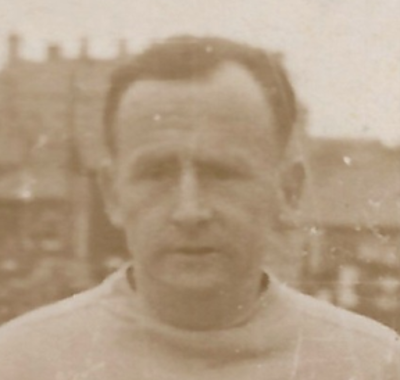
Rory’s family told us that despite the risks in the highly charged atmosphere in County Tyrone in the 1970s, Rory would remain irresistibly drawn to the conviviality and exceptional conversation of his old Coalisland friends.
1.14
Rory’s funeral took place on 7 March 1977 in St. Comgall’s Church, Brunswick Road in Bangor before he was laid to rest in Clandeboye Cemetery. A news outlet described the church as “packed with mourners and friends in his home town of Bangor, and in his native Coalisland”.2 Monsignor Mulally paid tribute to him by stating he was respected by all who knew him throughout his many years of service to the community.3
2 Belfast News Letter, 8 March 1977
3 The Irish News, 8 March 1977
1.15
Speaking on Rory’s character, his family said that he was a loving and attentive father who was inseparable from his children. He is remembered as a larger-than-life, funny and lovable man. His family told us that Rory “was and remains fifty years on, the light of our lives”.
Chapter 2: Rory O’Kelly‘s death and previous investigations (Back to top)
2.1
This chapter provides an overview of the circumstances of Rory’s death and the immediate events which followed. It also describes all previous investigations into Rory’s death.
2.2
Those investigations into Rory’s death included that of the Royal Ulster Constabulary (RUC), the coroner’s inquest, and the Historical Enquiries Team (HET). In this chapter we describe each previous investigation factually, based on the material the Commission has gathered and assessed.
The circumstances of Rory’s death
2.3
Rory, aged 59, was shot by a lone gunman while he sat in Lyttle’s Bar, Coalisland, shortly after 1pm on 4 March 1977. He died at the scene despite attempts by a doctor and ambulance staff to save him. Later that day, the Provisional IRA claimed responsibility for Rory’s killing in a statement issued to the news media. No one has ever been charged with his murder.
2.4
The RUC investigated Rory’s death in the immediate aftermath in 1977, and an inquest took place eight months later. The HET carried out a review between 2011 and 2012.
The events of 4 March 1977
2.5
Rory, a solicitor and Assistant Director of Public Prosecutions with the DPP, was born in Coalisland. On 2 March he left his family home in Bangor to visit Coalisland and stay with a friend for a few days. The primary purpose of the trip was to attend a funeral there on the morning of 2 March.
2.6
On the morning of 4 March, Rory left his friend John Malachy Quinn’s (known as Malachy Quinn) house and walked to Lyttle’s Bar, a pub in the centre of Coalisland, arriving at around 11.20am. He had parked his car outside of the pub the previous evening and mistakenly left some personal items (his pipe, tobacco and matches) in the pub. Ernest Lyttle, the bar owner allowed Rory entry to the pub, and inside he ordered a drink at the bar and went through to the back room. A short time later, two other local men, Patrick McGahan and Patrick Barkley, joined Rory in the back room and the three fell into conversation by the fire.
2.7
The two men in Rory’s company later told the RUC that they had been aware of another man entering the back room. One of the barmen, Charles McCook, recalled this man ordering a drink. While Charles McCook was at the bar making up the man’s order he heard a shot. This was about 1.05pm. He went through to the back room and found Rory lying in the corner. The man who ordered the drink had left.
2.8
At 1.10pm, the RUC at Coalisland station received a telephone call from Laura Lyttle of Lyttle’s Bar, reporting that Rory had been shot and was believed to be dead. Local RUC officers immediately deployed to the scene.
2.9
Two ambulance drivers were directed to the scene at a similar time. They arrived prior to the police and entered the pub via the side entrance and back door. They found Rory lying on the floor and, after checking for a pulse, tried to resuscitate him. A doctor attended but described Rory as being already deceased when he arrived.
2.10
RUC officers secured the scene. Specialist officers arrived, conducted a forensic examination of the scene, and took photographs. Officers spoke to witnesses present in the pub and conducted house-to-house enquiries locally. The Criminal Investigation Department (CID), based at Dungannon, took responsibility for the investigation of Rory’s death.
2.11
At 3.55pm an undertaker took Rory’s body from the scene to the mortuary at South Tyrone Hospital, Dungannon. The following day, at 3pm, Dr Derek Carson, the Deputy State Pathologist for Northern Ireland, carried out the post-mortem examination of Rory. The post-mortem found that his death was due to a single gunshot wound of the chest and would have occurred rapidly.
2.12
On 10 November 1977, an inquest into Rory’s death was held at the Courthouse in Dungannon. The jury returned an open verdict.
Royal Ulster Constabulary investigation
2.13
The CID, based at Dungannon, investigated Rory’s death. The senior investigating officer (SIO) was Detective Inspector Millar Farr. Officers from the Regional Crime Squad Southern Region assisted the investigation, as did officers from Coalisland station. Records do not indicate how many extra staff were deployed or for how long they supported the investigation.
The initial response
This section contains a scene plan on page 24, labelled Figure 2. This plan contains an illustration of the position of Rory’s body. Some readers may choose to move directly to the next section ‘Witnesses’.
2.14
At 1.10pm on 4 March 1977, the RUC at Coalisland station received a telephone call reporting that Rory had been shot. The Duty Officer at Coalisland station recorded in his statement that Laura Lyttle of Lyttle’s Bar, told him: “Rory T. O’Kelly, DPP prosecutor, was shot in Lyttle’s pub and as far as she knew he was dead.”
2.15
On receipt of the call reporting that Rory had been shot, officers began a Serious Incident Log. Officers used this to record actions taken during the management of an incident. The call was the first entry. The last entry was written into the log on 8 March 1977.
2.16
According to his statement, the Duty Officer immediately requested ambulance attendance from South Tyrone Hospital, Dungannon, then informed the sergeant in charge of Coalisland station, Sergeant Graham.
2.17
The Duty Officer also contacted Dungannon RUC station, informed Chief Inspector Magee and asked for the CID to visit the scene. The Duty Officer requested from Armagh RUC that specialist support branches, namely scenes of crime officers, mapping, and photography attend the scene.
2.18
The Duty Officer stated that he informed Rory’s brother, Colm, who said he would break the news to Rory’s wife. He asked Dungannon police to tell Rory’s sister, who lived locally.
2.19
Immediately following the call to the station, Constable A left on foot, arriving at Lyttle’s Bar at 1.12pm. Constable A and another constable were the first RUC officers to arrive at the scene. They entered the public house via the side entrance and back door and went into the back room.
2.20
Constable A saw the body of a male, who he later learned was Rory, lying on the floor at the right-hand side of the fireplace which was in the back wall. Members of the ambulance service were already in attendance.
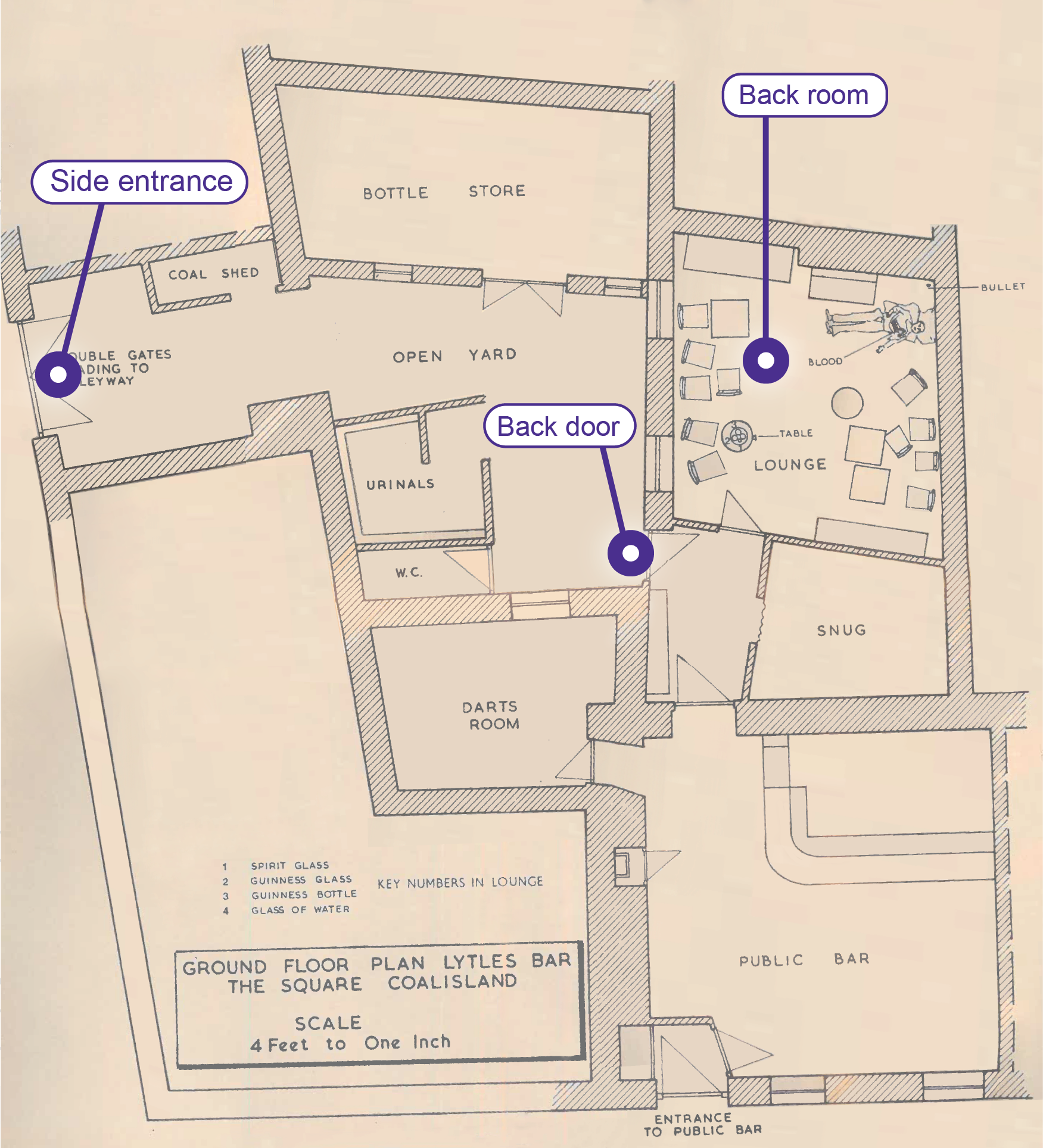
4 Figure 2 has been created using elements from two photographs taken of a paper copy of the floor plan. Digital adjustments have been made to remove shadows and creases. The changes were made manually without the use of artificial intelligence software.
Medical response
The following sections contain detailed descriptions of the scene of Rory’s murder. Some readers may choose to move directly to the next section ‘Witnesses’.
2.21
John O’Donnell, an ambulance driver and attendant, and his colleague Peter Cartmill, timed their arrival at Lyttle’s Bar as 1.15pm. They entered through the side entrance. John O’Donnell described going into the back room and seeing the body of a male lying in the corner, on his right-hand side.
2.22
He turned him onto his back and checked for a pulse. As he found no pulse, Peter Cartmill began giving cardiac massage, which had no effect. Constable A helped the ambulance workers. Attendant John O’Donnell placed a pillow under Rory’s head.
2.23
An RUC Medical Officer, Dr James Garvin, arrived at around 1.15pm and took over. He said in his statement that Rory was deceased when he arrived, and that ambulance men had tried unsuccessfully to revive him. He recognised the man to be Rory.
2.24
He examined Rory and found a bullet wound below his left shoulder and another below his right shoulder. In his opinion the wound below Rory’s right shoulder was “evidently the exit wound”. He added that the bullet was found in Rory’s clothes on the right side of his body.
2.25
The ambulance attendants helped to move Rory’s body, so the doctor could examine the wounds. When they left the room, Rory was lying on his back with the pillow still under his head.
2.26
Peter Cartmill described finding a bullet about four inches from the wall, in a position which would have been under Rory’s body prior to turning him. He put the bullet on the mantelpiece and later showed a police officer the position where he had found it.
2.27
Constable A said in his statement that while the ambulance workers were attending to Rory, he discovered what looked like the head of a .45 bullet on the floor at Rory’s right shoulder.
2.28
A Serious Incident Log entry at 1.15pm confirmed that there were two doctors present at the scene, including Dr Garvin. The same entry states Father O’Brien was also present. The RUC investigation did not take statements from the second doctor or Father O’Brien.
2.29
Both the Serious Incident Log and Constable A’s statement record Dr Garvin confirming Rory’s death at 1.15pm.
2.30
Rory’s friend Malachy Quinn officially identified him at around 3.45pm. An undertaker arrived at the scene at 3.55pm and transported Rory’s body to the mortuary at South Tyrone Hospital, accompanied by Constable A and another constable. The Serious Incident Log recorded Rory’s body having been removed from the scene at 4pm.
Examining the scene and recovering evidence
2.31
Constable A said that he took charge of the back room and preserved the incident scene. The Serious Incident Log recorded Sgt Graham sealing off the room.
2.32
Ch/Insp Magee from Dungannon, a detective sergeant from Special Branch and another detective constable arrived at the scene at 1.45pm.
2.33
The Serious Incident Log recorded that D/Insp Farr, a detective sergeant and three detective constables from Dungannon CID arrived at the scene at 1.55pm. They recorded ten witnesses present.
2.34
A short time later, at 2.08pm, a Scenes of Crime Officer arrived at the scene with another sergeant. The Scenes of Crime Officer carried out a forensic examination of the scene and took possession of three exhibits:
- Exhibit 1, which was a .45 bullet. This was found on the floor, four inches from the corner of the room.
- Exhibits ‘1a’ and ‘2a’, which were two palm prints taken from the top of a table in front of a bench seat where the suspect had sat at prior to the shooting.
2.35
The Scenes of Crime Officer completed a search for additional bullets, shells and strike marks but discovered none.
2.36
At 2.45pm, a constable arrived at the scene and took photographs. An action was raised for the constable to make a statement, but this was not completed. The material the Commission retrieved did not include a statement from this constable.
2.37
More officers arrived at the scene between 2.45pm and 3pm, including officers from Cookstown CID and the Regional Crime Squad.
2.38
Two hours after the shooting, at 3.10pm, Ch/Insp Magee searched Rory’s car and removed court files from it. He also arranged for the post-mortem to take place.
2.39
At the same time, the Scenes of Crime Officer searched Rory’s body. The Serious Incident Log recorded that D/Insp Farr took possession of Rory’s property which included the following items:
- one diary;
- one cheque book;
- a biro pen and refill;
- personal letter;
- door keys;
- receipts;
- two matches;
- car key ring;
- spectacles case;
- pound notes and coins; and
- a pipe and tobacco.
2.40
Two constables from the RUC Mapping Section arrived at the scene at 3.20pm and took measurements so that a map could be drawn up.
2.41
The Serious Incident Log recorded that the military searched the area at 4.10pm in an effort to find the weapon used in the shooting. They found no trace of it.
2.42
The Commission has seen no further documentation to confirm the parameters of the area searched. However, a handwritten note within the material reviewed recorded “Search of yard [and] outhouses re. possibility of gunman having left weapon at the shooting.” This likely refers to the open yard (Figure 2) the suspect would have passed through before exiting to Seagrave Terrace (encompassing toilets, a bottle store and coal shed). There is no further information in the note to understand who gave this instruction.
House-to-house enquiries
2.43
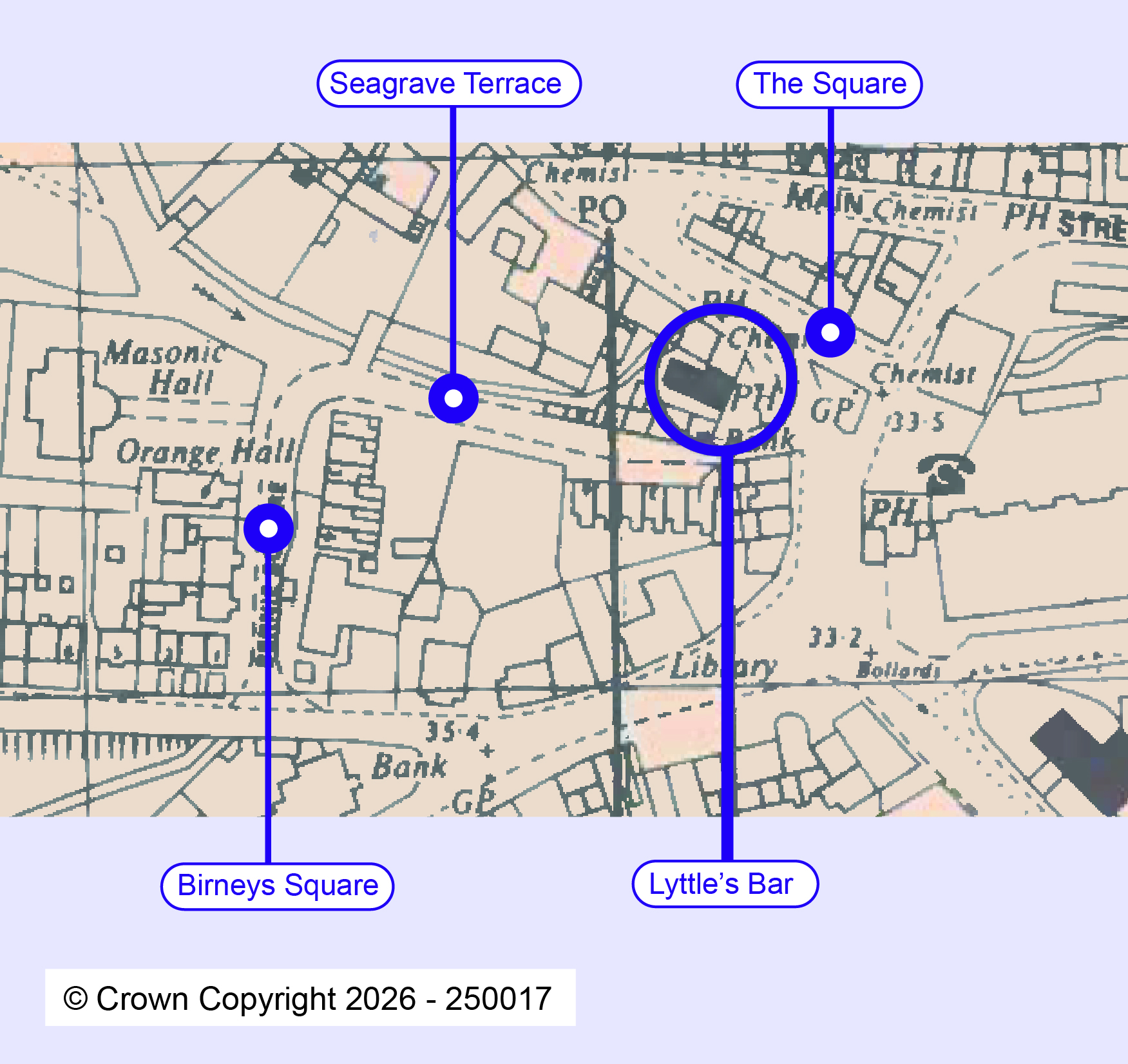
House-to-house enquiries in the area around Lyttle’s Bar were tasked to Sgt Graham and Constable A at 2.30pm. There is no documentation to confirm the parameters for the enquiries. However, house-to-house enquiry forms record the houses they visited, showing that they spoke to the occupants of eight homes on Seagrave Terrace and Birneys Square. These streets are at the side of, and lead away from, Lyttle’s Bar.
2.44
In another enquiry form, Sgt Graham recorded speaking to a resident of “Square, Coalisland,” a man who had been in Lyttle’s Bar on 3 March. The resident told Sgt Graham that he saw two strangers enter Lyttle’s Bar. The Commission understands this reference to be to ‘The Square’ at the front of Lyttle’s Bar.
2.45
None of the completed forms are dated or timed. The enquiries uncovered no further evidence, and the officers did not take any statements from anyone they spoke to during their enquiries. There is no record of the RUC investigation documenting or revisiting addresses where enquiries proved negative, such as where the occupants were not present or were otherwise occupied.
Witnesses
2.46
The RUC investigation identified five key witnesses who had been in Lyttle’s Bar and took statements from them. These were two men, Patrick McGahan and Patrick Barkley, who had been drinking with Rory when he was shot, the owner of the bar, Ernest Lyttle, and two members of staff, Charles McCook and Hugh Pat O’Neill.
2.47
The RUC investigation also identified and obtained information from other customers who had been in Lyttle’s Bar on 4 March when Rory was shot, or had been there the previous evening when Rory also attended the pub.
2.48
Other individuals, such as the friend Rory stayed with and his driver during his time in Coalisland, gave information to the RUC investigation about Rory’s movements in the days prior to his killing.
Persons Rory spent most time with during his visit to Coalisland
2.49
The RUC investigation sought to establish Rory’s movements in the days leading up to his death. Much of what the RUC learned came from statements given by Malachy Quinn and John Mallon. Both provided statements to the police shortly after Rory’s murder that corroborated each other.
2.50
Malachy Quinn was a 54-year-old builders’ clerk who had known Rory all his life as they used to live near each other in Coalisland. They had shared interests such as the theatre and writing. Rory had stayed at his home while on this visit to Coalisland. Malachy Quinn provided a statement to the RUC investigation at 3.10pm on 4 March.
2.51
John Mallon had known Rory for about twenty years, but he had not seen him for about two years prior to this visit.
2.52
Malachy Quinn said that Rory had arrived at his home just before lunchtime on 2 March. The pair had lunch and then drove into Coalisland in Rory’s car and went to Lyttle’s Bar. Malachy Quinn said they spent about half an hour in the “back snug” of the bar (not to be confused with the back room of the public house). He also stated that a man, who used to be a member of their amateur dramatic society, came in and spoke to Rory for about five to ten minutes.
2.53
Malachy Quinn said he then left the bar to try and find someone to drive Rory’s car. Both men had been drinking and Malachy Quinn thought “it would be better to be on the safe side”.
2.54
Malachy Quinn found and spoke to John Mallon, who agreed to drive. In the statement he subsequently gave to the police, John Mallon confirmed that Malachy Quinn had approached him while he was in the Central Bar, Coalisland. He told the police that he had driven for Rory on other occasions in similar circumstances.
2.55
From Coalisland, the three men travelled to Maghery, about ten miles away, arriving at approximately 3.30pm. There they had a meal, at Corr’s Corner. Malachy Quinn recalled Rory having a conversation with a priest he had known at college, believed to have been the Parish Priest at Carrickmore. Later that evening, the three men left Maghery and went to the Stagger Inn.
2.56
The three men went back to Lyttle’s Bar at around 10pm. They stayed there until about 11.15pm, according to Malachy Quinn. He said they were sitting both in the snug they had been in earlier in the day, and the back room. John Mallon stated they stayed in the back room until closing time and that the only other persons that came into the room were barmen.
2.57
When they left, John Mallon drove them the short distance to where Malachy Quinn lived, passing through a police vehicle checkpoint on the way. Checkpoints were a common feature in Northern Ireland at the time. Neither man provided any detail about the nature of their interaction with the police, other than Malachy Quinn saying it lasted a few seconds.
2.58
That evening Rory stayed at Malachy Quinn’s home. John Mallon continued onwards in Rory’s car to his own home. Before parting, Rory told John Mallon to pick him up in the morning to take him to court in Lurgan.
2.59
According to his statement, the following morning at 9.30am, John Mallon collected Rory from Malachy Quinn’s home and drove him to Lurgan. They arrived at the court a little early and spent some time talking in the car. Rory told him that he only had a couple of cases. Rory got out of the car, removed some papers from the boot and went into the courthouse, leaving John Mallon in the car.
2.60
Rory returned after about three quarters of an hour and put papers back into the boot. John Mallon said that Rory asked to go to the Country Club in Lurgan and there the two men had lunch.
2.61
From there they travelled to Corr’s Corner, Maghery, where they had been the previous day, and stayed for two to three hours. John Mallon said that no one else joined their company at either location, although Rory had spoken to a barman from Coalisland at Corr’s Corner.
2.62
The two men left and travelled back to Coalisland. This time Rory drove and told John Mallon that he would be going home that night. John Mallon recalled the time was about 6.30pm. Rory parked in Seagrave Terrace, “on the right as you come in from Birney[s] Square”, and the two men went into Lyttle’s Bar. John Mallon said they went into the back room of the pub again and for a short time Patrick McGahan joined them.
2.63
Rory and John Mallon left Lyttle’s Bar together. John Mallon recalled that Rory told him that he was going home but needed to see John J Quinn (the uncle of Rory’s friend Malachy Quinn) first. Rory left his car where he had parked it, and the pair walked up to the chapel next to John J Quinn’s home where they parted at around 8.30pm to 8.40pm. In his statement John Mallon said he was under the impression that Rory would return home to Bangor after he had seen John J Quinn.
2.64
John J Quinn gave an account to the RUC on 14 March 1977 which they recorded in an action sheet. He said that after Rory arrived at his home around 9pm, the two men went to the Inn on the Park, Dungannon. Later that evening, at about 11pm, Rory and John J Quinn returned to John J Quinn’s home address. Rory had coffee and toast and stayed until just after midnight (about 12.30am on 4 March). Rory then left to go to Malachy Quinn’s (the nephew of John J Quinn) home address.
2.65
In his police statement Malachy Quinn said that he had not seen Rory until the next morning, as he had been in bed when Rory arrived back at his home in the early hours of 4 March.
2.66
On Friday morning, Rory mentioned to Malachy Quinn that his car was parked at the back of Lyttle’s Bar. Rory left just after 11am, at the same time as Malachy Quinn’s wife, leaving Malachy Quinn the impression he was going “round the back way into Lyttle’s Bar” to collect his car (it is possible that Rory’s Rover car, identified as a 2000 model in the Serious Incident Log, is shown in RUC photographs, Figure 7 and Figure 8, but the Commission cannot be certain of this).
Further information about Rory’s movements prior to his death
2.67
The RUC gained further information about Rory’s movements on the days prior to his death during their investigation.
2.68
Although Rory was not working on 2 March, he attended the office in Newtownards in the morning and collected two files. According to information from the area Director of Public Prosecutions for Newtownards, he was due back at the office on 4 March as he had a case that day.
2.69
The files Rory collected were in relation to the cases he was due to deal with at Lurgan Court the following day, 3 March. One file was in relation to the Portadown area Ulster Volunteer Force (UVF) and the second was in relation to Na Fianna Éireann.
2.70
The RUC investigation confirmed that on 2 March, Rory had met with the manager of Northern Bank, Market Square, Dungannon before lunch and had arrived on his own.
Customers in Lyttle’s Bar who spoke with Rory
2.71
On 4 March at 2.10pm, Patrick McGahan, a 60-year-old farmer from Dungannon, gave a statement to a detective constable at Coalisland. The detective recorded the statement in his notebook and D/Insp Farr later certified a typed version as a true copy.
2.72
In his statement, Patrick McGahan said that he had been in Coalisland that day on business and called into Lyttle’s Bar at about 11.45am. He went round the side of the bar and into the back room where he found Rory sitting alone, to the right of the fire.
2.73
A short time later, also around 11.45am, “Paddy” Barkley came into the room and sat to the left of the fire. Patrick McGahan sat between the two men, facing the fire. Patrick McGahan said that the three of them had a general conversation lasting for some time.
2.74
Patrick McGahan said that at some point during their conversation another person came into the back room. Patrick McGahan did not look round at this person although he noted in his statement that he appeared to be sitting at the back of the room near the door.
2.75
Patrick McGahan remembered this man ordering a drink and the barman, Charles McCook, bringing this in. After the barman left, the next thing Patrick McGahan remembered was talking to Rory and hearing a shot. Patrick McGahan described Rory falling into the corner. Patrick McGahan realised Rory had been shot and said that he devoted his whole attention to him.
2.76
When he was able to look around, Patrick McGahan saw that the male who had been sitting at the back of the room had left without touching his drink. Patrick McGahan said he went into the bar and informed people there what had happened.
2.77
On 4 March, Patrick Barkley, a 62-year-old council workman from Coalisland, gave a statement at Coalisland RUC station.
2.78
In his statement, Patrick Barkley said that he went into Coalisland at about 11.45am that morning and went to Lyttle’s Bar where he had a couple of drinks. Inside the pub he went into the back room where he found Rory and “Paddy McGahan” sitting beside the fire. In his statement, Patrick Barkley confirmed he did not know Rory prior to this.
2.79
Patrick Barkley got into conversation with Rory and Patrick McGahan “about horses and pigs and things in general”. Rory bought both the men drinks. Patrick Barkley described Rory as being friendly and talkative.
2.80
Patrick Barkley said he saw “a young lad” come into the room. He took a seat at the back of the room and did not speak to the three men. Patrick Barkley heard him order a drink which the barman left the room to get for him. Patrick Barkley said the barman served the man and then left the room again.
2.81
As soon as the barman had left, Patrick Barkley heard a shot and saw a flash. He described Rory falling immediately into the corner of the room and the man leaving by the back door. In his statement, Patrick Barkley described the man as being 22 or 23 years old, 5’8” or 5’9” in height, with black hair and a thin face, wearing dark clothes. He also said, “he was a stranger to me”.
2.82
Patrick Barkley also said that he had been in Lyttle’s Bar the previous evening but did not remember seeing Rory there then.
Bar owner
2.83
Ernest Lyttle, the 63-year-old owner of Lyttle’s Bar, gave a statement to the RUC on 5 March. He said that after he had let Rory into the pub, he served him and then left the bar to go into the kitchen.
2.84
Laura Lyttle, who ran Lyttle’s Bar with her husband, told police in her statement that she was washing the hallway between the kitchen and the front door when at “about five past one” she heard “a noise like a slate breaking”.
2.85
Ernest Lyttle described being in the kitchen when he heard “a crack”. The barman, Hugh Pat O’Neill, then came into the kitchen and said: “Ring the police, [O’]Kelly’s been shot.” Laura Lyttle said she responded by running upstairs and phoning Coalisland RUC station to report what had happened.
2.86
Neither Ernest nor Laura Lyttle saw the gunman. Ernest Lyttle told the RUC investigation that Rory had been in the bar the previous evening.
Bar workers
2.87
Constable A spoke to Charles McCook, a 64-year-old labourer from Coalisland, at the scene and he provided immediate details of the crime, including a description of the “youth” seen in the bar shortly before the shooting of Rory.
2.88
On 4 March he gave a statement to the RUC. He explained that he helped Ernest Lyttle in his bar every day and had started work at 11am on 4 March.
2.89
He recalled Rory coming into the bar and retrieving the items he had left the previous evening. He said that Rory bought him a drink and that the two of them went into the back room. On finishing his drink, Charles McCook left to do some jobs around the bar. He saw Patrick McGahan come into the bar, order a drink and take that drink into the back room where he joined Rory in conversation.
2.90
In the period that followed, Charles McCook said he went twice into the back room to take drink orders. On the second occasion he saw that there was another man in there who he did not know, “on the form [table] at the door”. This man ordered a “Bush and a stout”. Charles McCook said that he would “get it for him in a minute” but the man remarked that he was in a hurry.
2.91
Charles McCook described this person as 19 or 20 years old, 5’8” in height, of thin build, with short black hair, wearing a blue denim jacket, brown trousers and a shirt and tie. He spoke softly and “appeared to have a local accent”. Charles McCook had not seen the man previously.
2.92
Charles McCook left the back room to get the man’s order and “a matter of seconds later”, while he was in the bar, he heard a shot.
2.93
Charles McCook went into the back room and saw that Rory was lying slumped in the corner of the room. He said that from how Rory appeared he knew that he had been shot and that he presumed he was dead. He ran back into the bar and told Hugh Pat O’Neill what had happened. In turn, Hugh Pat O’Neill ran into the Lyttle’s home and told Ernest Lyttle. A short time later, Ernest Lyttle came into the bar and said he had told his wife to phone the doctor, police and priest.
2.94
In his statement, Charles McCook confirmed that when he returned to the back room after hearing the shot the only persons present were Patrick McGahan, “Paddy” Barkley and Rory. The other person, whose drink order he had taken, had left.
2.95
Charles McCook also said in his statement that Rory had been in the bar the previous evening. He described him as popular and well respected locally.
2.96
On 5 March, Hugh Pat O’Neill, a 65-year-old part-time barman at Lyttle’s Bar, gave a statement to the RUC investigation. In his statement he described how he had been to a funeral in Clonoe earlier on 4 March. He arrived back in Coalisland and went to Lyttle’s Bar at about 12.20pm.
2.97
While he was working in the bar, Hugh Pat O’Neill said he heard the bell ring from the back room. He estimated the time as about 1.10pm as “the one o’clock news was on”. He went into the back room and found Rory, “Paddy” McGahan and “Paddy” Barkley present. Rory ordered drinks and Hugh Pat O’Neill returned to the bar to serve those. He put the drinks on a tray and gave them to Charles McCook to take through to the back room.
2.98
Charles McCook came back to the bar with another drinks order, “a Bush and a Guinness”. Hugh Pat O’Neill set these drinks down on the tray. He then heard a loud bang. Charles McCook took the drinks through to the back room but came immediately back, saying that Rory had been shot and that the man who had ordered the Bush and Guinness had left. Hugh Pat O’Neill’s statement contained no more information as to what he did next.
2.99
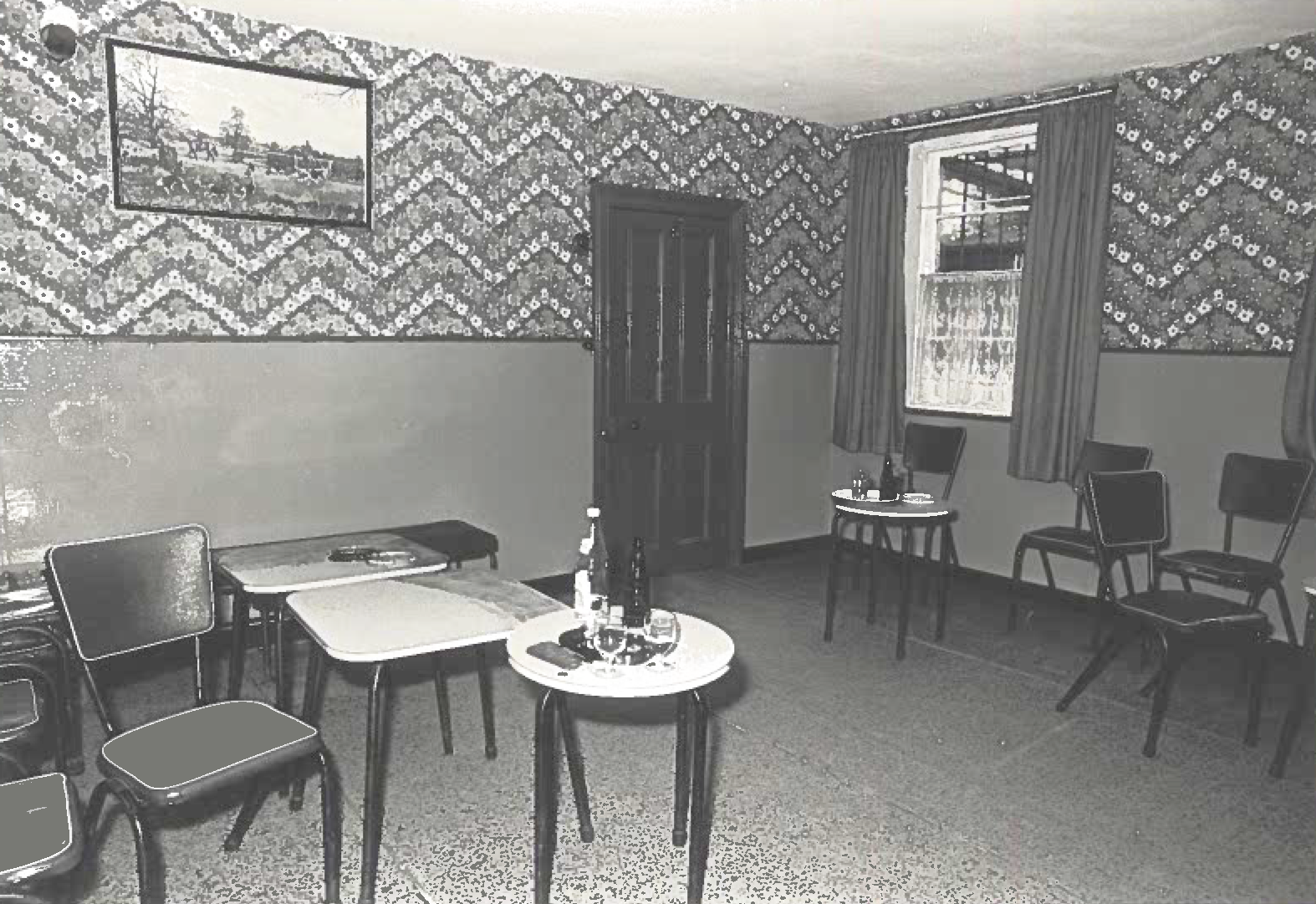
At some point Charles McCook put the drinks intended for the unknown male down in the back room. They can be seen, still on the tray, in one of the photographs of the scene (Figure 4) and are marked on the scene plan of the bar (Figure 2). There is a small discrepancy in the witness accounts in that the two customers in Rory’s company believed the barman had served these drinks to the unknown male in the back room. It seems likely they saw the drinks on the table and assumed they had been served to the male. The accounts of Charles McCook and Hugh Pat O’Neill suggest that before Charles McCook could serve the drinks a shot had been fired and the unknown male had left.
Other potential witnesses in Lyttle’s Bar on 3 or 4 March
2.100
The Serious Incident Log recorded that some of the first RUC officers at the scene ascertained those witnesses who were present.
2.101
Constable A then compiled a list of individuals who were in Lyttle’s Bar on the evening of the 3 March and the morning of the 4 March. This information was recorded in the Serious Incident Log at 10am on 6 March. A total of 21 individuals were identified as being present on 3 March and 12 individuals were identified as being present on 4 March.
2.102
On 6 March, D/Insp Farr raised a number of actions for officers to interview customers who had been in Lyttle’s Bar on either the morning of 4 March or evening of 3 March. The action sheets directed that officers were to speak to the individuals with a view to obtaining written statements if they were relevant to the investigation.
2.103
RUC officers took statements from five customers who had been in the public bar area at the front of the pub (see Figure 2) on 4 March. None saw the shooting, although some described hearing the gunshot. None of the witnesses provided information that would have helped identify the gunman.
2.104
The RUC identified and spoke to others who had been in the pub and were potential witnesses. However, the officers determined these individuals did not have relevant information that would warrant obtaining statements from them.
2.105
None of the customers who had been in the pub only on the evening of 3 March gave a statement to the RUC investigation. However, one of the customers, who knew Rory well, told police that Rory “had come to Coalisland for the funeral of Mrs Canning”. This information was recorded on a police action sheet, completed on 7 March.
Arrests
2.106
RUC officers investigating Rory’s death arrested two males on 4 March. The action sheets referred to each as “Suspect”. The material the Commission’s investigators obtained and reviewed is unclear on what connection the arrests had to Rory’s killing, other than that they took place in the immediate aftermath of Rory’s killing and were directed by the SIO, D/Insp Farr.
2.107
We therefore consider them as persons of interest rather than suspects and refer to them as ‘Person A’ and ‘Person B’ in this report. We have not used their names to protect their anonymity, as there is no evidence to link them to Rory’s death.
2.108
An entry in the Serious Incident Log at 5pm on 4 March recorded that “Enquiries revealed that [Person A] was in the area of the shooting when police arrived at the scene.” The entry further recorded that D/Insp Farr directed that Person A be brought to the station for interview.
2.109
According to the log, at 5.20pm, the sergeant allocated to the task provided information that Person B was in possession of a firearm and had threatened Person A. In response, D/Insp Farr directed that Person B be located and brought to the station for interview.
2.110
A short time later, at 5.45pm, an RUC constable arrested Person A and took him to Dungannon police station. Later that evening, at 7.45pm, the sergeant and a police constable arrested Person B and took him to Dungannon.
2.111
The following day, D/Insp Farr raised actions for both Person A and Person B to be interviewed.
2.112
The RUC interviewed Person B on 5 March at 12.05pm in relation to his movements on 3 and 4 March and obtained a statement from him. The RUC materials include no subsequent reference to Person B, but the subsequent HET SIO Review Report notes he was released without charge.
2.113
Person B’s statement recorded that he was a labourer from Coalisland and was 22 years old. His statement outlined his movements on 3 and 4 March. It did not make any reference to him having any dealings with Rory, the shooting in Lyttle’s Bar, nor did it shed any light on the alleged threat made to Person A.
2.114
On 6 March, the detective sergeant recorded that Person A had been detained overnight and that statements had been obtained about the allegations he had made. He was released from custody without charge. However, the Commission has found no statement from Person A, nor any documentation to confirm what allegations he made in the material we have reviewed.
Suspect photofit
2.115
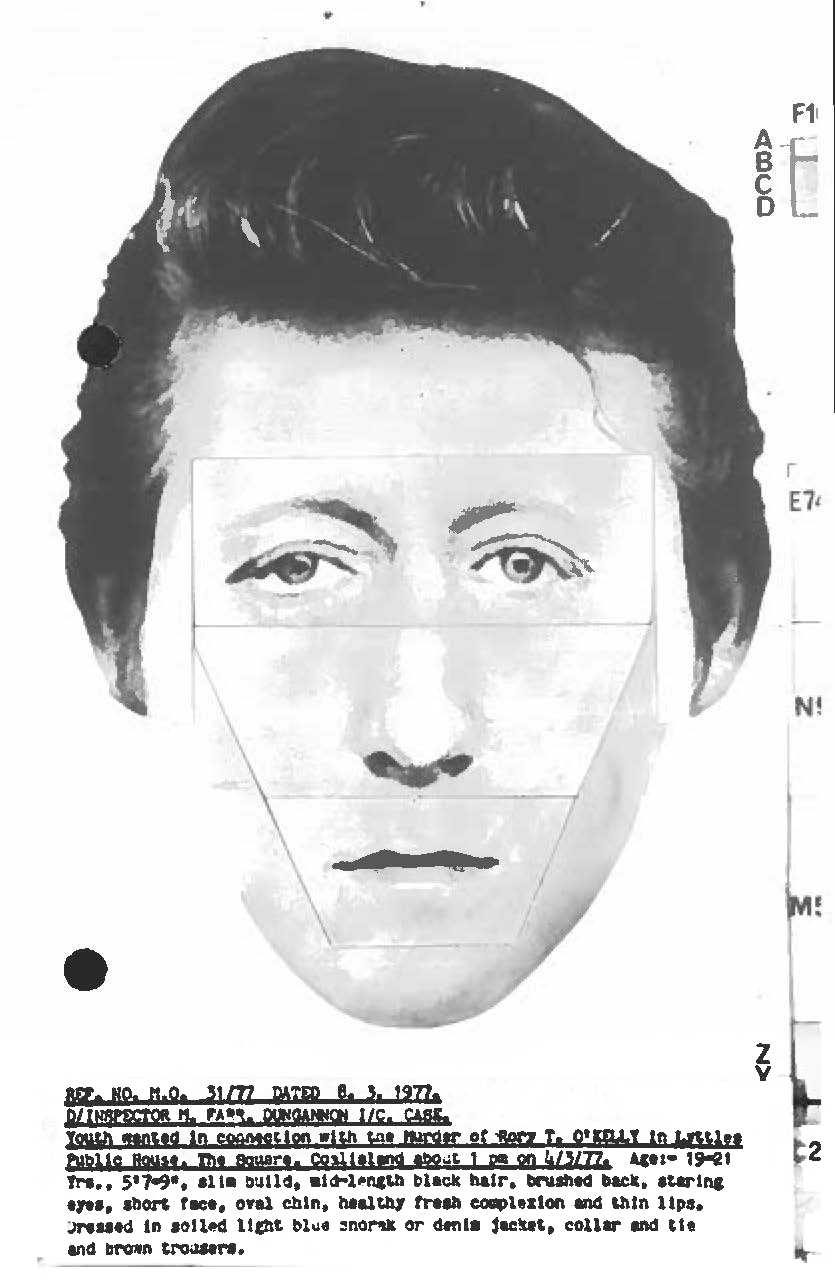
The Serious Incident Log recorded that on 8 March, Charles McCook, helped the RUC investigation produce a photofit of the suspect at Dungannon station.
2.116
The photofit was entitled: “Youth wanted in connection with the Murder of Rory T. O’Kelly.” Beneath the image was the following description of that person:
Age: – 19-21 Yrs., 5’7-9”, slim build, mid-length black hair, brushed back, staring eyes, short face, oval chin, healthy fresh complexion and thin lips. Dressed in soiled light blue anorak or denim jacket, collar and tie and brown trousers.
2.117
The RUC material contained a typed note dated 15 March 1977 signed by D/Insp Farr. The purpose of the note was to circulate the circumstances of Rory’s death and photofit of the “culprit”. D/Insp Farr requested: “Any information regarding this incident or possible identity of the culprit should be passed to CID Dungannon as soon as possible.” It is unclear who received this note or to whom it was circulated as the recipient is blank.
Post-mortem examination
This section describes the fatal injuries that Rory sustained. Some readers may choose to move directly to the next section ‘Forensics’.
2.118
Dr Derek Carson, Deputy State Pathologist for Northern Ireland, carried out the post-mortem examination of Rory on 5 March 1977 at 3pm at the mortuary of South Tyrone Hospital, Dungannon, as instructed by the Coroner J P Shearer. Constable A identified the body to Dr Carson.
2.119
The same constable who took photographs of the scene took photographs during the post-mortem examination as instructed by Dr Carson.
2.120
The Report of Autopsy recorded the cause of death as “bilateral haemothorax due to laceration of innominate and left common carotid arteries and lungs due to gunshot (0.45 ACP) wound of chest”. ACP stands for Automatic Colt Pistol. Dr Carson gave the following opinion:
“Death was due to a single gunshot wound of the chest. A bullet had entered the front of the left upper arm at its junction with the chest, and had then passed from left to right through the upper chest, finally leaving through the right upper arm. The precise track of the bullet passed from left to right, downwards at about 10° to the horizontal plane and very slightly backwards. It must thus have been fired from a weapon almost directly to the left to the deceased. There was no indication from the appearance of the entrance wound as to the range from which the shot was discharged. The size and appearance of the entrance and exit wounds were consistent with the bullet of 0.45 calibre.”
2.121
Furthermore, Dr Carson stated that “[d]eath, due to massive internal bleeding, would have occurred rapidly” and that “[t]he gunshot wounds apart, there were no other marks of recent violence”.
2.122
The Scenes of Crime Officer received the following items from Dr Carson:
- Grey jacket
- Brown overcoat
- Sample of blood for grouping
- Sample of blood for alcohol
- Sample of urine
2.123
The remaining clothing taken from Rory was given to the sergeant at Coalisland.
Forensics
2.124
The RUC investigation sent several items for forensic examination to advance their enquires. The blood and urine samples taken during the post-mortem examination were submitted for grouping and alcohol content.
Ballistics
2.125
On 5 March, the Scenes of Crime Officer submitted the .45 bullet to the forensic laboratory at the Department of Industrial and Forensic Science. On 6 March, the Scenes of Crime Officer submitted Rory’s grey jacket and brown overcoat.
2.126
As part of the submission, D/Insp Farr requested that the bullet be examined to identify the weapon used and whether it had been used previously and for the clothing to be examined to establish the possible range of firing.
2.127
The Serious Incident Log recorded that on 7 March, a member of staff from the Data Reference Centre, which at the time examined weapon linkages after forensic opportunities had been explored, informed the investigation by telephone call that the gun used to kill Rory was thought to have been used in four previous incidents in 1976.
2.128
A subsequent report from the Data Reference Centre dated 14 March confirmed the information. The weapon used to kill Rory was believed to be a Colt .45 pistol, used previously in four shootings in 1976. These incidents were recorded in the report as follows:
- 3 January – attempted murder at Fred Martin’s Garage, Killymoyne (the Commission notes this is possibly Killymoyle);
- 22 January – shooting at Grubina Lane, Eglish, Dungannon;
- 29 March – attempted murder, North Street, The Square, Stewartstown;
- 16 June – attempted murder, North Street, Stewartstown.
2.129
In his statement dated 28 April, a forensic scientist identified the bullet used in the shooting of Rory as a “.45 ACP copper jacketed bullet, rifled 6 grooves left hand twist.”
2.130
The same scientist also examined the jacket and overcoat Rory had been wearing and found a bullet exit hole in the left arm of both items, in corresponding positions. No bullet entry hole was located in either item.
2.131
A review of the forensic file has identified that the bullet recovered from the scene at Lyttle’s Bar was transferred from the laboratory that conducted the forensic work to the Data Reference Centre on the 11 June 1979 for storage.
Fingerprints
2.132
Two palm prints recovered by the Scenes of Crime Officer from the tabletop where the gunman had been reported sitting on 4 March, were sent to the Fingerprint Department on 7 March to be examined to try to obtain evidence of their identity.
2.133
A report from the Acting Inspector of the RUC Fingerprint Department on 8 March confirmed that the department had examined the two palm prints and found them “to contain insufficient ridge detail for comparison and have accordingly been eliminated”. They were subsequently destroyed.
Further actions raised in October 1977
2.134
The RUC material contained four documents, titled Further Action 1, Further Action 3, Further Action 4 and Further Action 5. These were all raised on 18 October 1977. There is no record of a Further Action 2 in the material the Commission has reviewed. The signature of the officer raising the actions is not legible, but it does not match D/Insp Farr’s signature on actions that had been raised in March.
2.135
The actions related to:
- obtaining files for the incidents connected by use of the same firearm;
- interviewing a customer who had been at Lyttle’s Bar when Rory had been shot and had previously been spoken to by the RUC investigation on 5 March (during house-to-house enquiries);
- obtaining a report from the sergeant at Coalisland; and
- a request for clarification as to the result of the forensic examination of the palm prints located at the scene.
2.136
It is not clear from the material assessed what prompted the actions to be raised in October, but it is likely that they were raised to serve the inquest which took place in November. No records in the material reviewed by the Commission confirm this.
2.137
Ultimately, while these actions were completed, they did not provide new information to advance the RUC investigation any further. The RUC did not charge anyone in connection with Rory’s killing.
Coroner’s inquest
2.138
On 10 November 1977, an inquest into the death of Rory was held at the Courthouse, Dungannon, County Tyrone. The coroner was J P Shearer. He described Rory as “a well-known and prominent figure not only in Coalisland, but throughout the province”.5
5 Belfast News Letter, 11 November 1977
2.139
The coroner read D/Insp Farr’s statement to the court. The inquest heard evidence from:
- Sergeant A (employed as Constable A at the time of Rory’s death);
- Dr Garvin (the RUC medical officer who attended the scene);
- Malachy Quinn (Rory’s friend with whom he stayed in Coalisland);
- Ernest Lyttle (bar owner);
- Charles McCook (bar worker);
- Hugh Pat O’Neill (bar worker);
- Patrick McGahan (witness from the bar); and
- Patrick Barkley (witness from the bar).
2.140
On 10 November 1977, an inquest into the death of Rory was held at the Courthouse, Dungannon, County Tyrone. The coroner was J P Shearer. He described Rory as “a well-known and prominent figure not only in Coalisland, but throughout the province”.
2.141
After hearing all the evidence, the jury returned an open verdict.
2.142
Coroner’s courts in Northern Ireland commonly used the term open verdict at the time of Rory’s inquest. The relevant coronial rules required the coroner, or their jury, to establish how, when and where the person died but prevented them from expressing an opinion on criminal or civil liability. The coroner and jury had a limited set of conclusions they could deliver in their ‘verdict on inquest’ form as follows: died from natural causes; died as the result of an accident/misadventure; died by his own act; execution of sentence of death; or open verdict. The rules directed that an open verdict was to be used where none of the other forms of verdict applied.6
6 The Coroners (Practice and Procedure) Rules (Northern Ireland) 1963
2.143
In 1980, coronial rules replaced verdicts with the term ‘findings’, allowing coroners in Northern Ireland to give more of a commentary on the circumstances of a death than had previously been the case.7
7 The Coroners (Practice and Procedure) (Amendment) Rules (Northern Ireland) 1980
Historical Enquiries Team investigation
2.144
The HET began an investigation into Rory’s death in October 2011. The investigation was given the operation name ‘Corpus Christi’ and reference number AM 40.
2.145
The HET tried to contact Rory’s wife and one of Rory’s children by letter on 24 October 2011. The HET sent all letters as registered mail and obtained proof of delivery. No response was forthcoming.
2.146
Her Majesty’s Inspectorate of Constabulary (HMIC) was commissioned to inspect the role and function of the HET in 2012 and reported its findings in 2013. The HMIC report describes the way HET conducted its cases. In cases where the family of the deceased chose not to engage with HET, the case would go to the Non-engagement Assessment Team for review. In most cases, an SIO would then produce a review report. In cases where the family of the deceased did engage, the HET often produced a more detailed review summary report.
2.147
In the absence of any contact with the family, the case of Rory’s death was referred to the Non-engagement Assessment Team on 24 November 2011.
2.148
The SIO completed an SIO Review Report on 8 March 2012. The HET SIO reports were not for release to the family. That position is still the same today. The aim of the review was to concentrate on the following:
- prepare a brief summary of the case;
- identify evidential opportunities; and
- complete a Collection Assessment Review template to facilitate analysis and linkages.
2.149
The SIO report contained an overview of the circumstances of the killing of Rory. The review is organised under the following headings:
- witnesses (here the review drew from the inquest file and listed four people as principal witnesses, the owner of Lyttle’s Bar, two members of staff, and Dr Garvin);
- post-mortem examination;
- inquest proceedings;
- review of original case papers and investigation;
- suspects and persons of interest;
- tactical assessment (of cases linked via the gun used to kill Rory);
- forensics (scenes, exhibits and fingerprints);
- summary of intelligence;
- review of open source material; and
- family engagement.
The report ended with the SIO’s conclusions and recommendations.
2.150
To inform their review of the case, the HET reviewed the case papers from the original RUC investigation. These included:
- serious incident log;
- police report;
- witness statements;
- post-mortem photos;
- maps;
- Public Record Office of Northern Ireland file;
- post-mortem report;
- inquest file;
- duty officer’s report;
- form 19 (likely the police report concerning the death sent to the coroner);
- house-to-house enquiry forms;
- consolidated non secret intelligence report;
- suspect photofit; and
- message forms.
2.151
The HET made enquiries to determine whether the .45 bullet recovered at the scene, and Rory’s “clothing” (which was his grey jacket and brown overcoat) were in existence so that they could consider further forensic examinations. The SIO report documents that no items were recovered from Forensic Science Northern Ireland and that the available records show the items were returned to the police in 1977.
2.152
The SIO report also stated that the two “imprints” were confirmed to have been destroyed along with the fingerprint file. A further comment notes that the case papers show “two fingerprints were found on the table where the gunman was sitting.” From the RUC material the Commission has assessed, these are understood to have been two palm prints, not fingerprints.
2.153
The SIO report referenced a ballistics intelligence report which identified the firearm used to kill Rory as a “0.45 ACP calibre Colt Model: 1911 A1 semi automatic pistol”. The report found that the weapon had also been involved in one murder and three attempted murders prior to the shooting of Rory. It was also subsequently involved in one murder, two attempted murders, one shooting incident and one incident where spent cases were recovered. The SIO report did not contain dates or locations for these incidents but confirmed that the firearm used to kill Rory was recovered on 13 July 1984.
2.154
In relation to intelligence, the SIO report found that: “There was no prior intelligence in this case, which could have prevented Rory’s murder.” The report referred to limited intelligence received by the original investigation. The SIO report concluded with the following, produced here in full:
“The case papers and intelligence show that a good investigation was carried out and suspects arrested but no evidence was obtained to link anyone with the murder. No further lines of enquiry have been identified, and I recommend that CPFE [‘Compliant Pending Family Engagement’] letters are now sent.”
2.155
On 24 April 2012, HET sent another letter to Rory’s son but again received no response. The final note from the SIO, dated 21 May 2012, asked for the case papers to be returned to store, databases to be updated for the case to be filed CNFE (‘Compliant No Family Engagement’).
Chapter 3: The Commission’s investigation (Back to top)
3.1
This chapter covers all stages of the Commission’s work on this case; from the moment Rory’s family first contacted the Commission to the publication of this report.
3.2
The chapter opens by describing our engagement with the family as the case has progressed. It also outlines the family’s reasons for contacting the Commission and provides an overview of the questions they asked us to answer.
3.3
The chapter then turns to the Commission’s investigation, covering what we learned from our assessment of existing information, before describing the further actions investigators took to try to understand all the circumstances of Rory’s death.
Family engagement
3.4
On 12 September 2024, Rory’s son, Roger, contacted the Commission to ask for an investigation into the fatal shooting of his father Rory O’Kelly at Lyttle’s Bar, Coalisland, County Tyrone on 4 March 1977.
3.5
Trevor Ringland of Macaulay & Ritchie Solicitors, Belfast, acted as proxy for Roger in his communications with the Commission.
3.6
Following initial contact with the Commission, we allocated the family a Case Support Worker. Early engagement focused on understanding the family’s concerns, the questions they wished the investigation to address and how the Commission could support their participation in the process. This engagement informed the family’s request for an investigation.
3.7
In November 2024, the Commission accepted the case, a Senior Investigating Officer (SIO) was appointed, and the Case Support Worker informed the family. This contact was followed up with an in-person meeting in December, in which senior representatives of the Commission discussed their plans for investigation with the family.
3.8
In January 2025, the Investigation Team, in collaboration with the Reports and Findings Team, provided preliminary answers to the original seven questions the family had asked when they approached the Commission.
3.9
In July 2025, after the Investigation Team assessed the existing information, the SIO shared Terms of Reference with Rory’s family via their solicitor. These outlined the scope of the investigation which the Commission would carry out.
3.10
On 1 October 2025, during the course of the Commission’s investigation, Roger died. Prior to his passing, the Chief Commissioner, Deputy Commissioner for Investigations and an investigator visited Roger to share significant amounts of information about the case. This included preliminary answers to the questions the family had asked based on the Investigation Team’s interpretation of the documentation recovered during their investigation. Anne, Rory’s daughter, was also present at this meeting. In line with Roger’s wishes and the Commission’s statutory powers the investigation continued.
3.11
In March 2026, the Commission was concluding its investigation. The Case Support Worker and one of the Commission’s investigators met with Anne and her solicitor to explain how the case would progress on completion to the Findings stage. They also discussed publication of the report and the ways Anne could contribute to the report by providing information about Rory in Chapter 1.
3.12
On 16 April 2026, Roger’s sister and Rory’s daughter, Anne, formally continued the family request on Roger’s behalf. Anne had attended previous meetings with the Commission and continued with the same solicitor as proxy.
3.13
In April 2026, the family’s solicitor gave the Commission six further questions endorsed by Anne. All the family’s questions are included in Chapter 5.
Gathering and assessing existing information
3.14
At the beginning of its investigation into this case, the Investigation Team issued requests for information to Relevant Authorities.8 Investigators made requests to:
- The Police Service of Northern Ireland (PSNI) for all records held in relation to Rory, including the HET report and all associated documents. As the current body responsible for policing in Northern Ireland, the PSNI holds RUC files.
- The Public Record Office of Northern Ireland for the inquest files relating to the death of Rory and any relevant records held.
- The Coroners Service of Northern Ireland for coronial material relating to Rory’s death and any correspondence with members of the family.
- Forensic Science Northern Ireland for the full forensic file of all investigation papers and material relating to the death of Rory, including all exhibits and confirmation where any exhibits had been returned to the police.
- The Ministry of Defence for material held about deployments in and around the location of Lyttle’s Bar on 4 March 1977 and any material relevant to Rory’s death.
- MI5 for any material identified as relevant to Rory’s death.
8 The Northern Ireland Troubles (Legacy and Reconciliation) Act 2023 s5(1) requires Relevant Authorities to make available to the Commission information, documents and other material as reasonably required for the exercise of its review function. A list of Relevant Authorities is defined in s60 of the Act.
3.16
During their assessment of the information provided, investigators found that the weapon used to kill Rory had been used in previous incidents both prior to and after Rory’s killing. One of these incidents occurred on 15 March 1977, when someone used the weapon used to kill Rory to fatally shoot Corporal David Graham at his workplace in Coalisland. The Provisional IRA admitted the shooting. Corporal Graham died ten days later.
3.17
Due to the short 11-day time frame between both shootings and that both incidents occurred in Coalisland, a second request was issued to the PSNI for information and material relating to the murder of Corporal Graham. This was to determine whether it held any relevant information relating to the shooting of Rory.
What we established
3.18
The documentation received provided our investigators with information on the direction and progress of the RUC investigation into Rory’s death. This included witness statements, forensic records, scene photographs, exhibit records, the autopsy report and the Serious Incident Log. From that information, it was clear that the RUC investigation established many of the circumstances surrounding Rory’s death.
3.19
On 4 March 1977, a statement was issued to the news media purporting to come from the ‘Mid-Ulster Brigade’ of the Provisional IRA claiming responsibility for Rory’s killing. The Commission’s investigators did not view any material within the existing information which undermined that statement.
3.20
The Investigation Team’s assessment of the existing material also suggested that the original investigation lost momentum relatively quickly, with the last entry in the Serious Incident Log being made on 8 March 1977. That assessment also identified gaps in our understanding of the RUC’s investigation, that if answered, would help further inform our investigation and answer the questions asked by the family.
Witnesses
3.21
The Investigation Team established that two local men, Patrick McGahan and Patrick Barkley, were in Rory’s company when he was shot in the back room of Lyttle’s Bar. A barman, Charles McCook, had taken a drinks order from the suspect immediately prior to the shooting. He provided a statement to the RUC investigation stating he may recognise the suspect again and helped an RUC officer complete a photofit of the suspect.
3.22
It is not known whether or how the photofit was circulated. It is also not known whether any possible suspects were suggested in response to the creation of this photofit.
3.23
Eight of the nine house-to-house enquiries recorded by the RUC investigation were located on Seagrave Terrace and Birneys Square. This suggested that the RUC were of the view that the gunman left Lyttle’s Bar via the side entrance and made his escape via Seagrave Terrace. Only one enquiry appears to have been conducted in the area around the main square in Coalisland, at the front entrance to Lyttle’s Bar, and where it would be expected more people may have been present.
Exhibits
3.24
From their assessment of the RUC investigation papers, investigators established that the bullet that killed Rory was found in his clothes and picked up by an ambulance attendant who placed it on a mantlepiece in Lyttle’s Bar. It was then moved by an unknown person back to its original discovery location on the floor, before being removed from the scene. This sequence of events was not recorded in the exhibiting officer’s statement.
3.25
It was not known at this stage of the Commission’s investigation whether the bullet still existed. If it was located, investigators would need to consider matters including integrity and continuity for potential DNA examination.
3.26
From their assessment of the existing material, investigators understood that the Deputy State Pathologist, Dr Derek Carson gave Rory’s jacket and overcoat to the Scenes of Crime Officer and the rest of his clothing to a sergeant at Coalisland.
3.27
The Investigation Team found no statement from that sergeant within the material they reviewed. There is no further documentation within the material the Investigation Team viewed to confirm what the sergeant did with the clothing or whether the RUC ever returned it to the family.
3.28
In an internal RUC communication dated 21 August 1978, the Sub-Divisional Commander asked the then Detective Inspector of Dungannon CID for confirmation of the whereabouts of the clothing taken by the Scenes of Crime Officer and when the items can be returned to a named friend of the family. The subsequent series of internal communications confirms that Rory’s jacket and overcoat were added to the Special Property Register at Coalisland RUC Station at the end of October 1978.
Suspects
3.29
The Investigation Team identified that the RUC investigation had no viable suspects. We learned from the existing information that two individuals were arrested but no one was charged.
3.30
Person A and Person B were arrested, interviewed and released without charge during the original investigation. The Commission’s investigators found no further information as to the context of the threat alleged to have made by Person B in the material reviewed. The information available from the interview of Person A only conveys that statements were made about his allegation. The information available shows that Person B was questioned about his movements on the 3 and 4 March 1977 (the days before and of Rory’s murder).
Intelligence
3.31
Intelligence is not the same as evidence. It comes from different sources and in different forms, and its value can vary widely. For this reason, intelligence is assessed and graded based on its relevance and reliability.
3.32
The HET’s SIO expressed the opinion that there was no prior intelligence that would have prevented Rory’s murder.
3.33
The RUC investigation received no intelligence sufficient to allow them to advance their investigation. Within RUC documentation, there was intelligence over a two-year period from the date of Rory’s murder, which named seven other persons in connection with his death. However, the reports were all single strand (a single piece of uncorroborated information), ungraded and offered no further lines of enquiry.
3.34
Internal RUC correspondence from the Divisional Commander to the Chief Constable stamped 9 March 1977, also stated:
“There has been very little information obtained on the movements of the gunman in this case. This is surprising having regard to the local connections of the victim and the sympathy which his death received.”
Investigation type
3.35
The review of the material indicated that potential prosecutions in this case were unlikely. This was due to the absence of witnesses or their ability to recall owing to the passage of time, the lack of forensic opportunities and any information linking people to the case. For these reasons, the Commissioner for Investigations decided to conduct a Focused Investigation.9
9 The Operational Design Framework, Independent Commission for Reconciliation and Information Recovery, 9 July 2024, page 35 (https://icrir.independent-inquiry.uk/document/icrir-the-operational-design-framework/)
3.36
A Focused Investigation:
- Aims to recover information that answers the family’s questions.
- Draws on previous investigative work.
- Conducts targeted new investigative work where it will help address the family’s questions.
- Can access sensitive information when required.
- Results in a public report that details all findings of the investigation.
- Findings, based on analysis of the material recovered by the investigation, are made on the balance of probabilities, meaning that it is more likely that not that something happened.
3.37
The Focused Investigation which followed in this case sought to establish the circumstances of Rory’s death, further understand the extent of the original RUC investigation and answer the family’s questions.
Terms of Reference
3.38
The Investigation Team developed Terms of Reference setting out the scope of the investigation and shared them with Rory’s family via their solicitor in July 2025. He confirmed that the family was content with the Terms of Reference and emphasised some matters which were important to the family concerning the extent of previous investigations by the RUC and HET.
3.39
The Terms of Reference remained the same during the investigation.
Investigative actions
3.40
The Commission’s Focused Investigation into Rory’s death undertook a number of investigative actions to address the family’s questions, with a view to informing a public report. These are set out below in the following thematic sections:
- Understanding the RUC investigation.
- Locating exhibits.
- Considering opportunities for forensic analysis.
- Reviewing the firearm history.
- Reviewing intelligence.
- Identifying the funeral Rory attended.
- Identifying the second doctor at the scene.
Improving our understanding of the Royal Ulster Constabulary investigation
3.41
Following review of the existing material by the Investigation Team, the SIO identified gaps in the Commission’s understanding of the RUC investigation into Rory’s death.
3.42
The SIO considered it necessary to gain a better understanding of the original SIO’s investigative strategy. The Investigation Team also wanted to find more information about the arrest of two individuals on the day of Rory’s death, the extent of the use of the photofit, any identification procedures and the receipt and analysis of any intelligence or information received by the RUC investigation. To this end, the SIO requested the following actions:
- Trace and engage with D/Insp Farr.
- Locate and obtain D/Insp Farr’s daybook.
- Identify any other officer involved in the investigation who could provide an overview of the investigation.
- Locate and obtain a copy of the Police Gazette to confirm circulation of the suspect photofit.
- Locate and obtain RUC force orders or notices with regards to serious crime/murder investigations.
Identifying Royal Ulster Constabulary policy governing murder investigations
3.43
In September 2025, investigators attended the Police Museum, Belfast, to review the RUC Code and Manual which governed murder investigations in 1977. The RUC regularly updated the manual and code, marking updates with the month and year of update at the bottom of the page.
3.44
Investigators reviewed the 1986 manual titled “The RUC Code, general orders for the Government & guidance of the force, volume two, issued by the Chief Constable”. This document contained sections that the RUC updated between December 1976 and January 1977. This guidance applied to the investigation team in March 1977.
3.45
The manual covered investigating, recording and reporting crime in Section 29. A sub-section set out the core procedures for investigating murder and other major crimes. The sub-section outlined the six principal points RUC officers should attend to when conducting a murder investigation. These were:
- Speedy communication of all information available.
- Arrangements for the pursuit of the criminal.
- Preservation of the scene until a proper examination could take place.
- Examination of the scene.
- Post-mortem examination.
- Interviewing and examination of suspects.
Tracing former Royal Ulster Constabulary officers
3.46
The Investigation Team made enquiries through the PSNI Legacy and Disclosure branch with the aim of tracing and speaking with former D/Insp Farr, the SIO in charge of the RUC investigation into Rory’s death.
3.47
The PSNI confirmed to the Commission that former D/Insp Farr was deceased. Investigators could not pursue this line of enquiry further.
3.48
D/Insp Farr’s daybook was not amongst the material received from the PSNI and reviewed by the Commission. Some officers would retain their daybooks after they left the service, but without being able to contact D/Insp Farr, the Investigation Team could not confirm whether he kept any such material from his time in the RUC. The Investigation Team decided it would not be proportionate to trace D/Insp Farr’s next of kin to pursue this line of enquiry further.
3.49
The Investigation Team provided the PSNI with details of eight other RUC officers who they had identified as having played a significant role in the RUC investigation into Rory’s death.
3.50
Where the PSNI were able to find details of the former officers, they confirmed to the Commission which officers were still alive. Of those, Constable A was the first officer to arrive at the scene and undertook several enquiries in the initial stages of the investigation. Therefore, the Investigation Team decided that he was the former officer most likely to be able to provide further information about the investigation.
3.51
In October 2025, investigators spoke to former Constable A at his home address. Investigators provided him with a copy of the statement he gave in 1977 about his involvement in the investigation of Rory’s death. They asked him several questions about his recollection of the incident and the actions he carried out.
3.52
Investigators asked former Constable A about the parameters of the RUC’s house-to-house enquiries. He confirmed he conducted house-to-house enquiries along Seagrave Terrace and Birneys Square because both witnesses and the RUC investigation team told him that the suspect came and left through the back door. However, he was unable to recall with whom he conducted these enquiries, nor if he conducted other enquiries on other streets.
3.53
On the investigation’s strategy around identifying witnesses, he confirmed he gave the RUC investigation team a list of witnesses who were present at the time. He took statements from those who had seen anything significant. He also confirmed that an experienced constable gave CID a list of names of people he believed were likely to have been in the pub.
3.54
An entry in the Serious Incident Log recorded that the early RUC officers at the scene found that ten witnesses were present in the pub. A further entry, on 6 March 1977, recorded that Constable A forwarded the names of 12 witnesses who were present at Lyttle’s Bar on the morning of 4 March and a further 21 witnesses present on the evening of 3 March. These names were recorded in the Serious Incident Log. Investigators considered it highly likely that the experienced constable referred to by former Constable A contributed to the additional names forwarded by Constable A, based on his experience and local knowledge.
3.55
To support the answering of the family’s questions, investigators also asked former Constable A if Father O’Brien had administered the last rites to Rory at the scene. An entry in the RUC Serious Incident Log recorded that Father O’Brien was there when the first RUC officers arrived. Former Constable A did not remember Father O’Brien being present.
3.56
The investigators concluded that former Constable A’s overall memory of the incident was understandably affected by the passage of time.
Understanding whether identification procedures were conducted
3.57
The Investigation Team’s review of the action sheets from the RUC investigation showed that Charles McCook helped produce a photofit of the suspect. It also showed a note from D/Insp Farr indicating that he intended the photofit to be circulated. However, the recipient part of the form was left blank and the Commission’s investigators could not establish who this note was circulated to.
3.58
In July 2025, members of the Investigation Team visited the Police Museum, Belfast to view copies of the Police Gazette from 1977. Their aim was to understand the extent to which the RUC investigation had circulated the photofit. Investigators found no relevant information in any of the Gazettes they reviewed.
3.59
Investigators reviewed three-quarterly compilations of the publication, covering the remainder of the calendar year 1977 following Rory’s death, for any references to the fatal shooting of Rory and the suspect photofit.
3.60
The Investigation Team asked the PSNI Legacy and Disclosure branch to confirm the status of the sergeant who compiled the photofit, with the aim of contacting him to establish whether he had any knowledge of identification procedures adopted by the RUC investigation. Without further details, such as his station or service number, neither of which exist in the limited references within the existing RUC materials, the PSNI Legacy and Disclosure Branch could not confirm the identity of the sergeant based on the name alone. The Investigation Team could not pursue this line of enquiry further.
3.61
When investigators spoke to former Constable A he could not confirm with certainty whether the RUC investigation had used the suspect photofit in an identification process.
Making visits to the scene
3.62
In April and August 2025 members of the Investigation Team attended Coalisland to visit the scene. The primary reason was to better understand the parameters of the house-to-house enquiries during the original RUC investigation and to determine whether those enquiries were a proportionate response to the incident the RUC were investigating. Investigators also traced the most likely route Rory took from Malachy Quinn’s home address to Lyttle’s Bar.
3.63
The documentation shows two RUC officers had visited eight homes on Seagrave Terrace and Birneys Square as part of the house-to-house enquiries. Their enquires uncovered no additional evidence and they took no statements.
3.64
Lyttle’s Bar no longer exists. At the time of Rory’s murder, Lyttle’s Bar operated out of a large, terraced property. The front of the premises was between Northern Bank and a local chemist. Two petrol pumps were directly outside the front entrance. The bar overlooked The Square, a main thoroughfare containing commercial premises. The bar had a side entrance on Seagrave Terrace. Seagrave Terrace is a narrow road that runs from The Square into Birneys Square.
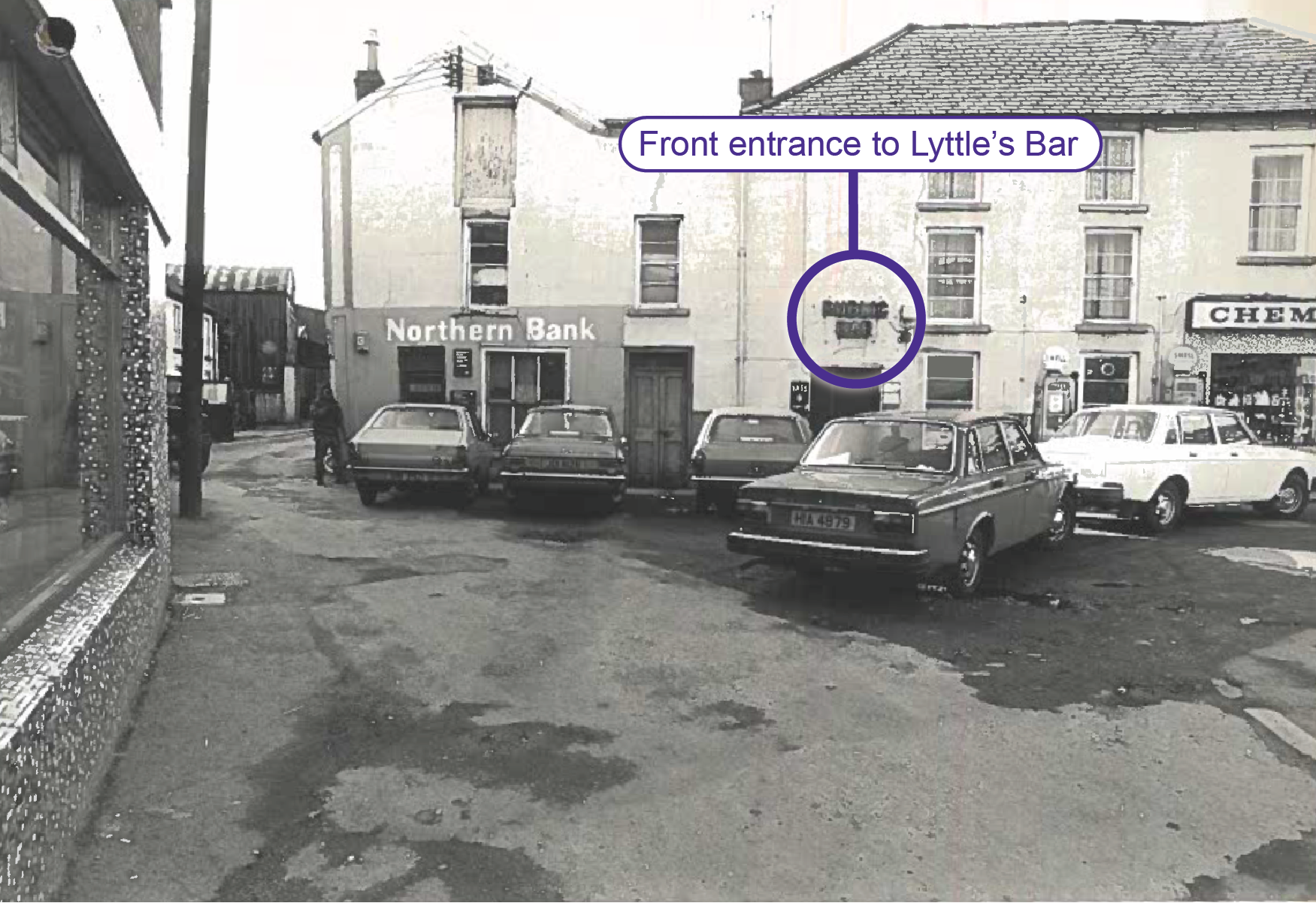
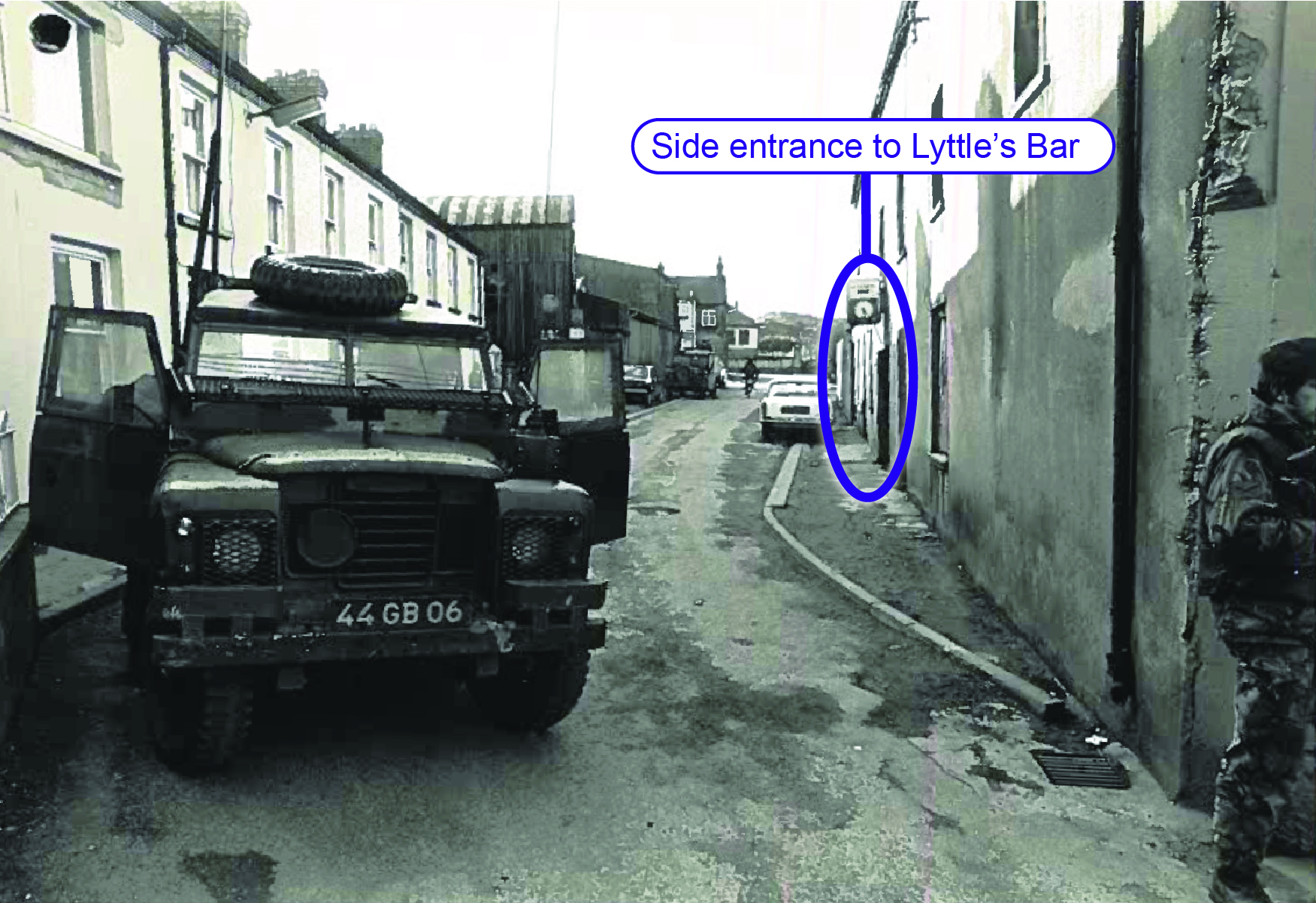
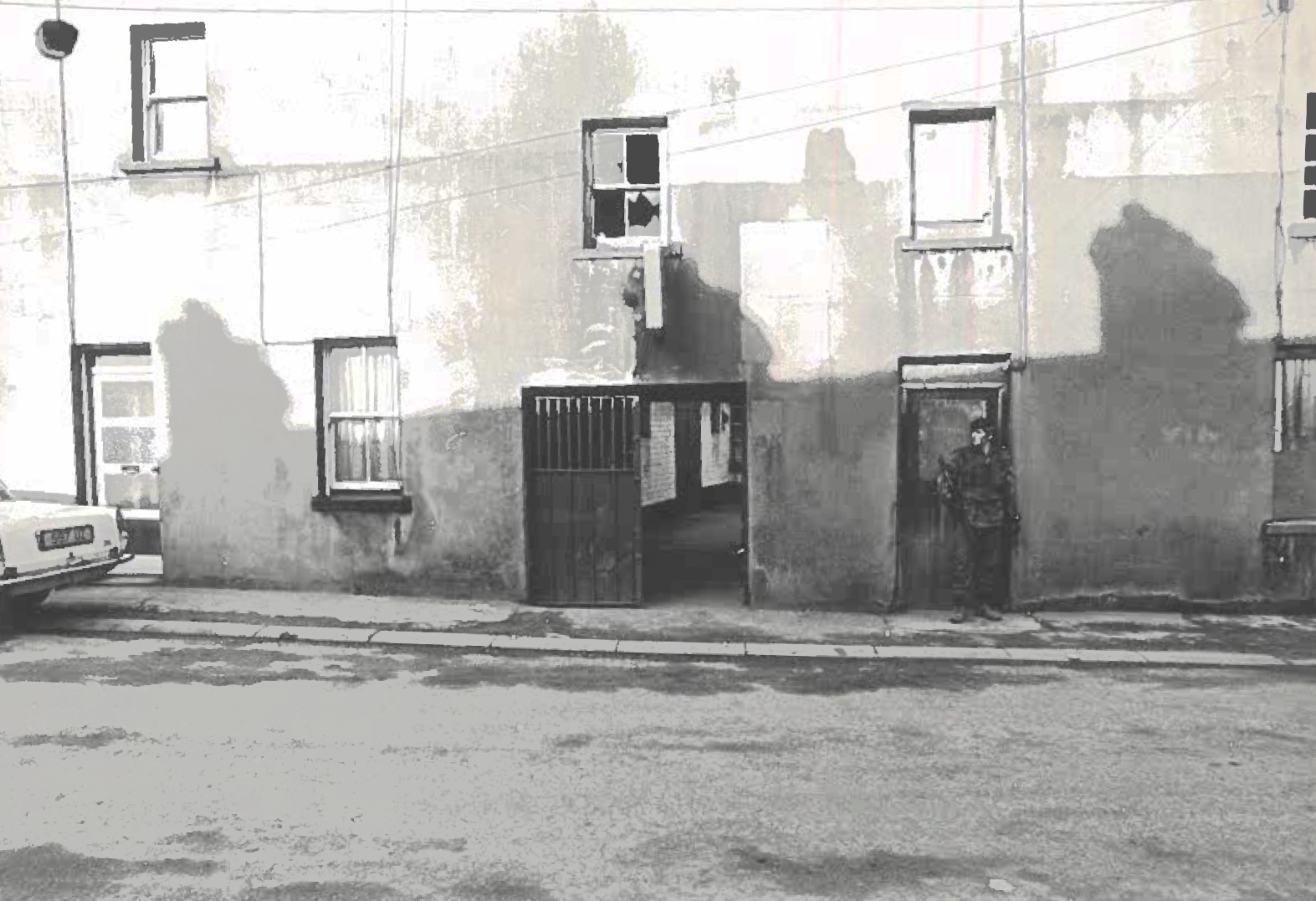
3.65
Witness information from the scene suggested the suspect left Lyttle’s Bar through the back door and side entrance onto Seagrave Terrace. The Commission’s investigators believed it likely that the suspect turned right towards Birneys Square when they exited the side entrance. This was likely the best route as it minimised potential witnesses in the main square.
3.66
Therefore, although the house-to-house documentation initially appeared scarce and mainly focused on one area, an examination of the scene and the witness information helped Commission investigators understand the rationale of the house-to-house enquiries and clarified that the RUC activity was proportionate.
Considering suspects
3.67
The Investigation Team tried to locate RUC custody records, interview notes and daily record sheets in relation to the arrests of Person A and Person B on the day of Rory’s death. The investigators aimed to understand the reason for their arrest and the content of their interviews.
3.68
The Investigation Team requested access from the PSNI to the custody records and Duty Officer’s Report, if in existence, in relation to both individuals. On 16 June 2025, the PSNI confirmed that the records could not be located, so this action did not advance the Commission’s investigation.
Locating exhibits
3.69
The Investigation Team tried to identify and locate items taken as exhibits by the RUC investigation and any other items that might advance its investigation.
3.70
Investigators contacted the Serious Crime Exhibit Stores and the Centre for Information on Firearms and Explosives (CIFEx) at the PSNI to find out if they still had any exhibits or Special Property Registers in storage that related to Rory’s murder.
3.71
The PSNI confirmed that the C6 Occurrence Book for the Coalisland area from the time of Rory’s murder was in storage at the Serious Crime Exhibit Stores. A C6 Occurrence book was a written log of any event which occurred in a police station area which was reported to police. On 28 April 2025, investigators visited the Serious Crime Exhibit Store to examine the book but did not identify any additional information which was not already in the material they had previously reviewed.
3.72
The PSNI shared the CIFEx file related to the weapon used to kill Rory with Investigators in July 2025. The file included Weapons and Explosives Research Centre incident documentation and photographs of the .45 bullet that killed Rory. The material received from Lyttle’s Bar on 4 March still exists and CIFEx still holds it.
3.73
Investigators tried to trace the clothing Rory was wearing at the time of his death. From their review of the existing material, they found no document confirming that Rory’s clothing was returned to his family following his death. Internal RUC communication indicated that Rory’s jacket and overcoat were added to the Special Property Register at Coalisland RUC Station at the end of October 1978.
3.74
The Investigation Team tried to locate the Special Property Register at the Serious Crime Exhibit Stores. On 28 April 2025, the Serious Crime Exhibit Store confirmed that they did not have any registers from either Coalisland or Dungannon RUC stations from the time of the incident.
3.75
The Investigation Team then contacted the Dungannon PSNI station to determine if they held the register in storage there. Staff at the station informed Commission investigators that they did not have any special property registers from before 2007. They also advised that Coalisland RUC station closed in 2006. The Investigations Team concluded that it is likely that the RUC either lost or destroyed these items.
Considering opportunities for forensic analysis
3.76
The Investigation Team considered the potential for forensic examination of the bullet to progress the investigation.
3.77
In the 1970s, police did not handle or store evidence to today’s standards. The forensic techniques now used as standard practice did not exist in 1977. Police officers at the time had no way of knowing then what we would be able to recover using modern testing, so, during that time, strict anti-handling procedures were not adhered to. This means that evidence taken during the 1970s is very difficult to use for modern forensic testing today.
3.78
Forensic science has advanced significantly. We know now that every contact at a crime scene leaves a trace, however minuscule. This could be fingerprints, DNA, fibres or footwear marks. Because of this, it is very important that exhibits are handled and stored carefully to protect any evidence.
3.79
In this case, the Investigation Team identified contamination issues relating to the handling of the bullet found at the scene. From the review of the RUC investigation records, investigators learned that the bullet was moved before RUC officers recovered it.
3.80
In addition, it is likely that contact with the inside of the barrel and heat exchange during the firing of the bullet core dramatically reduced any DNA and/or fingerprint opportunities.
3.81
The Investigation Team considered these circumstances, along with the lack of information relating to suspects, and determined that submitting the bullet for DNA examination was unlikely to progress our investigation. On that basis, the SIO decided not to submit the bullet for examination.
Reviewing the firearm history
3.82
Following their review of existing information, investigators were aware that the firearm used to kill Rory was used in eight other incidents. The firearm was used four times before Rory’s death and four times afterwards. One of these was the murder of Corporal David Graham at Tamnamore Close, Dungannon, 11 days after Rory’s death. The South Derry Brigade of PIRA claimed responsibility for that killing.
3.83
During its assessment of existing information, the Investigation Team requested from the PSNI any information they held about the killing of Corporal Graham. This was received in March 2025. There was no information contained within the material received which further informed the Commission investigation into Rory’s death.
3.84
Subsequently, as part of their investigation, the Commission’s investigators sought to review all the cases linked ballistically to the shooting. In May 2025, the Investigation Team sent a series of additional requests for information to the PSNI. These requested the incident box and intelligence files in relation to six separate murders or attempted murders and one fatal shooting in which the firearm used to kill Rory was also present. The incidents were:
- An attempted murder at Fred Martin’s Garage in Killymoyne (the Commission notes this is possibly Killymoyle) on 3 January 1976.
- The murder of Kieran McCann on 22 January 1976. East Tyrone PIRA claimed responsibility for his killing.
- An attempted murder at North Street junction with The Square in Stewartstown on 29 March 1976.
- An attempted murder at North Street in Stewartstown on 16 June 1976.
- An attempted murder of an RUC officer at Coalisland police station on the 20 April 1977.
- An attempted murder at 28 Ballygawley Road on the 23 April 1977.
- The fatal shooting of William Albert Price on 13 July 1984 by the British Army, during which the weapon was recovered.
3.85
Between June and September 2025, investigators reviewed the above case files and associated intelligence at PSNI locations. There was no information within the case files that further advanced our investigation into Rory’s death.
3.86
The Weapons and Explosives Research Centre incident documentation contained within the CIFEx file, which the Investigation Team received from the PSNI on 29 July 2025, listed ten incidents where the weapon was used, in addition to the death of Rory. Two were incidents that the Commission was not previously aware of. These were:
- Shooting/fire at the Kildress Inn, Cookstown on 10 November 1977.
- The recovery of spent cases in Meenagh Park, Coalisland, on 24 May 1982.
3.87
The Investigation Team considered reviewing the above two incidents but decided not to pursue this line of enquiry. Investigators concluded that the limited evidence gained by the RUC investigation into Rory’s death, coupled with the contamination issues surrounding the bullet, made it highly unlikely that any material from these two incidents could add anything significant to their investigation of the case.
3.88
The Weapons and Explosives Research Centre incident documentation contained within the CIFEx file also documented that Weapons Control disposed of the firearm on 19 May 1992.
Reviewing intelligence
3.89
Based on the weapon history and a family question, the Commission’s investigators requested material from the PSNI and MI5 in relation to activities of the Provisional IRA in South Derry and East Tyrone in 1976 and 1977. Investigators received information from the PSNI and held a meeting with MI5 in London on 23 October 2025. Investigators found no reference to any involvement in or claim of responsibility for Rory’s murder.
3.90
The Commission’s investigators and researchers also undertook a detailed search of the PSNI digital systems for intelligence relating to Rory’s murder. This activity was undertaken in addition to assessing the information provided to the Commission by the Relevant Authorities. Within that material, there was reliable information indicating that PIRA leaders in Coalisland did not agree with the murder of Rory. They said the attack was the work of outsiders and claimed they knew nothing of the murder. Commission investigators and researchers found nothing within this material to suggest the persons arrested and released without charge by the RUC (Person A and Person B) participated in Rory’s murder.
Identifying the funeral Rory attended
3.91
The Duty Officer’s report referred to Rory having attended the funeral of a local councillor’s mother and an RUC action sheet recorded that a witness told police that Rory had come to Coalisland for the funeral of “Mrs Canning”.
3.92
The Commission identified that Catherine Canning, mother of Councillor Jim Canning of Dungannon District Council, died on 28 February 1977 and her interment and mass took place at 11am on 2 March at St Mary and St Joseph’s Church, Coalisland.
3.93
Jim Canning was elected as an SDLP councillor for Coalisland in 1973 and would have been well known to Rory because of his previous political involvement. It is unsurprising, therefore, that he should have wanted to attend the funeral of Jim Canning’s mother.
3.94
Rory was not expected at work on 2 March because of his intention to attend the funeral. However, he called into his office that morning to collect papers that he needed for the next day. He then made his way to Coalisland and had lunch with his friend Malachy Quinn.
3.95
The Commission saw no further documentation to confirm Rory’s attendance at the funeral but, in light of his expressed intention to attend the funeral, his obvious reason for doing so, the opportunity he had to do so by leaving work that morning and his sighting in Coalisland that lunchtime, it is likely that he did attend.
Identifying the second doctor at the scene
3.96
The Serious Incident log recorded a second doctor attending Lyttle’s Bar in response to Rory being shot. In April 2026, the family, acting in the belief that the doctor was still alive, asked the Commission whether the doctor might have relevant information about the incident.
3.97
In June, investigators made enquiries at the doctor’s surgery in Coalisland located closest to the incident. These enquiries confirmed that the second doctor had worked at the practice but had retired some years ago.
3.98
On 18 June, investigators attended the doctor’s home address and spoke with him. He confirmed that he was practising at the surgery in Coalisland at the time of Rory’s death.
3.99
While he initially struggled to recall the incident, after Commission investigators provided him with some information, he confirmed he could remember reading reports of Rory’s death. However, he could not remember attending the scene and was unable to provide any information to assist the Commission in answering the family’s questions.
Lines of enquiry not pursued
3.100
Commission investigators chose not to pursue several potential lines of enquiry after careful consideration by the SIO.
3.101
In an ordinary review of a fatal shooting, a potential line of enquiry would be to revisit significant witnesses, such as those in the bar when Rory was shot. Revisiting significant witnesses could be especially useful in Northern Ireland, where the social and political environment has changed and people’s willingness to provide information, originally held back through fear, may have changed.
3.102
However, in this case, a significant consideration was the length of time that has passed since the incident, the age of any witnesses that may still be alive, and, in that context, their potential ability to provide information to advance our investigation. Weighing up those factors, the SIO decided not to re-interview significant witnesses. Even if said witnesses were alive, the SIO assessed that the value of any approach would be minimal and not proportional when weighed against the potential detrimental impact on their wellbeing caused by any approach.
3.103
The Commission investigators considered undertaking renewed house-to-house enquiries, on the basis that the original records provided little information in relation to the original parameters and the extent of any such activity. However, given the length of time that has passed since the shooting, the likelihood of people at the time of the offence living in the same house today or having any additional specific recollection of the shooting was considered by the Commission to be remote.
3.104
The SIO considered a renewed media appeal. The incident was well reported at the time both in the written media and on television. As well as the RUC taking eyewitness statements and conducting house-to-house enquiries there was also a facility for people to provide information anonymously. The ages of any living witnesses are likely to be 100 years old plus. As such, the SIO ruled out a new media appeal.
Chapter 4: Analysis and findings (Back to top)
4.1
This chapter sets out the Commission’s analysis and findings following our investigation into Rory’s death. Findings are conclusions made by the Chief Commissioner, supported by the Reports and Findings Team, on the balance of probabilities.
4.2
The findings made and conclusions reached in this chapter are the result of the Chief Commissioner and Reports and Findings Team’s independent analysis of all the available evidence. This includes evidence obtained from previous investigations, the Commission’s own investigation and contextual evidence about the social and political context at the time of Rory’s death.
4.3
The balance of probabilities is the legal standard of proof that means something is more likely than not to have happened. This assessment must be a fair-minded and objective view of the evidence. While findings made on the balance of probabilities will always be to the standard of more likely than not likely, the Commission recognises that the more inherently unlikely an event is, the stronger the evidence that is required to establish that it is probable.
4.4
Where this chapter says that it is possible that something happened, this means that the evidence does not allow the Commission to find that something was likely, but the possible scenario is included to improve the reader’s understanding of the circumstances.
The circumstances of Rory’s death
4.5
This section sets out all the circumstances of Rory’s death and the findings we make about it. This includes how, when and where Rory died. It then covers our conclusions about the people responsible for Rory’s murder. The last subsection provides more detail on the Provisional IRA, which claimed responsibility for Rory’s murder. It gives information on its motivation for targeting Rory, and the role played by its ‘Mid-Ulster Brigade’.
How, when and where Rory died
4.6
At around 11.20am on 4 March 1977, Ernest Lyttle, who was in the process of opening Lyttle’s Bar, provided Rory access to the bar via the side entrance on Seagrave Terrace.
4.7
Rory had gone to Lyttle’s Bar that morning to collect his car, which he had parked outside the side entrance the previous evening. He had also mistakenly left some personal belongings inside the night before. Patrick McGahan and then Patrick Barkley joined Rory in the back room of Lyttle’s Bar at around 11.45am.
4.8
Shortly after 1pm, Rory, Patrick McGahan and Patrick Barkley ordered a drink from the barman Hugh Pat O’Neill. Hugh Pat O’Neill said that this happened at “approximately ten past one because the one o’clock news was on.” It is likely, however, that the men ordered drinks a few minutes earlier than ten past one based on the time Rory’s murder was reported by Laura Lyttle and the time the first RUC Officers said they arrived at the scene.
4.9
Close to this time, Patrick McGahan and Patrick Barkley observed a young man enter the back room and take a seat towards the back. They were still chatting with Rory at the time.
4.10
Hugh Pat O’Neill got the drinks Rory ordered, and Charles McCook took them to the back room. By this point, the young man, who was later identified as the gunman, was also seated in the back room and ordered a drink from Charles McCook. Although aware of the young man’s presence and the fact he had ordered a drink, Patrick McGahan and Patrick Barkley did not interact with him. Charles McCook returned to the bar with the young man’s drinks order.
4.11
Soon after Charles McCook left the room, Patrick McGahan and Patrick Barkley heard a gunshot. They saw Rory fall to the floor towards the corner of the back room. Around the same time, after putting the gunman’s drinks order on a tray for Charles McCook to take back into the room, Hugh Pat O’Neill said he heard a “loud bang”, which he thought sounded like a gunshot. On hearing the noise, Charles McCook returned to the back room within “seconds” of having left it. He saw Rory and thought he was dead.
4.12
Patrick McGahan, Patrick Barkley and Charles McCook all observed that Rory had been shot. None of them were able to provide the RUC with the time of the shooting.
4.13
At about 1.05pm, Laura Lyttle, who was nearby between the kitchen and the hallway, heard a noise like a slate breaking. Ernest Lyttle, also nearby, described hearing a “crack.” Due to the similarity of sound and timing of Rory’s death, it is likely that the sound they both heard was the gunshot.
4.14
A brief time later, Hugh Pat O’Neill came into the kitchen and told Laura Lyttle to “Ring the police, [O’]Kelly’s been shot.” Laura Lyttle went immediately upstairs and phoned Coalisland police station. The RUC recorded the time of this report as 1.10pm.
4.15
Ambulance workers Peter Cartmill and John O’Donnell were the first to the scene and described arriving at 1.15pm. Constable A said he arrived with another constable at 1.12pm noting that the ambulance workers were already in attendance but before the RUC Medical Officer Dr Garvin, who reported that he arrived at 1.15pm. It is therefore likely that Peter Cartmill and John O’Donnell arrived slightly earlier than they recalled.
4.16
The ambulance workers describe seeing Rory in the back room lying on his right-hand side. They turned him and checked for a pulse. Despite finding no signs of life, they made unsuccessful efforts to revive him. Dr Garvin confirmed that Rory was dead.
4.17
The ambulance workers helped move Rory’s body so the doctor could examine his wounds. One described placing Rory’s head on a pillow. When they left the room, Rory was lying on his back with the pillow still under his head.
4.18
Dr Carson, the pathologist who conducted the post-mortem examination the next day, gave the medical cause of Rory’s death as “due to a single gunshot wound of the chest.” He also found that there were no health issues, signs of natural disease or other marks of recent violence to affect this conclusion. He determined that Rory would have died rapidly due to massive internal bleeding.
4.19
One bullet was found at the scene. Peter Cartmill described finding this bullet about four inches from the wall in a position which would have been under Rory’s body when he had fallen on his right-hand side. He put the bullet on the mantelpiece and later showed a police officer where he found it. Constable A did not mention this interaction in his statement but said that while the ambulance workers were attending to Rory, he discovered what looked like the head of a .45 bullet on the floor at Rory’s right shoulder. Dr Garvin who examined Rory at the scene, also said the bullet was found on the right of his body but expressed it was in Rory’s clothes. Despite their variations, all three statements are consistent on the original position of the bullet.
4.20
Although the forensic scientist noted a bullet “exit” hole on the left arm of both Rory’s jacket and overcoat (but no entry hole), the opinions of the pathologist and doctor at the scene are more consistent with the evidence of where Rory fell and where the bullet was found. Both Dr Carson and Dr Garvin confirmed that the bullet had entered and exited Rory’s chest from left to right, meaning that the exit hole could not have been on the left arm of Rory’s clothing. Dr Carson’s autopsy report recorded that the bullet was fired “almost directly” to Rory’s left. It is possible that the forensic scientist was describing Rory’s clothing using a front-on view, in which case the correct side is reversed. It is also possible that he made a mistake and intended to refer to the entry hole. If the latter, and so the lack of an exit hole on Rory’s jacket and overcoat, it would explain the information provided by Dr Garvin that the bullet was found in Rory’s clothes on the right-hand side of his body.
4.21
Dr Carson and the forensic scientist both reported that the bullet came from a .45 automatic Colt pistol.
4.22
Taking all the above into account, the Commission finds that:
Rory died very shortly after 1.05pm on 4 March 1977 in the back room of Lyttle’s Bar in Coalisland. Rory was in the company of Patrick McGahan and Patrick Barkley when he died. He died rapidly due to a single gunshot wound to his chest fired from a .45 automatic Colt pistol. It is unlikely that he experienced any prolonged pain.
4.23
A priest, Father O’Brien, attended the scene of Rory’s murder. The Serious Incident Log recorded that Father O’Brien was there at the same general time as the first RUC officers at 1.15pm. It is likely that the priest arrived following a telephone call from the owner of the bar. Charles McCook told police that in response to the shooting, Ernest Lyttle had told Laura Lyttle to phone the “doctor, police and priest”. Laura Lyttle did not report phoning a priest in her statement and there is no police statement from Father O’Brien. There is no documentation which records the police speaking to Father O’Brien, nor any material which would assist in identifying him or indicating whether he provided last rites for Rory.
4.24
The fact that Father O’Brien attended the venue so soon after the shooting may well have been to administer last rites. During the Troubles/Conflict, it was often the case that when an incident of this seriousness occurred, a priest would be called. Last rites are only administered to the living. However, a person does not have to be conscious for a priest to provide the sacraments. It is likely that a priest rushed to a murder scene and unclear whether a person had passed would administer what last rites they could. A priest may also administer last rites ‘conditionally’ shortly after death.
4.25
When interviewed by investigators on 16 October 2025, former Constable A, the first constable on the scene, was asked about last rites. Former Constable A could not recall Father O’Brien and therefore could not state whether he had administered the last rites.
4.26
Taking all the above into account, the Commission finds that:
It is possible that Father O’Brien administered the last rites to Rory, but the lack of evidence prevents the Commission from saying that it is probable it occurred.
The gunman responsible for Rory’s murder
4.27
The witnesses sitting with Rory in the back room were not facing the gunman who killed Rory and did not see him point and fire the gun. They did not mention anyone else entering the room except for the barman and the gunman. No one reported a man going through the public bar towards the back room. It is most likely that the gunman had entered the pub through the back door and therefore also from the side entrance on Seagrave Terrace.
4.28
There are no reports of the gunman being in the bar before he ordered a drink around 1.05pm. His limited actions during that time can be drawn out from the witness statements: he sat down at a table towards the back of the room, ordered two drinks but drank neither, said that he was in a hurry, waited for the barman to leave the room, shot Rory, and left immediately.
4.29
Patrick Barkley saw the gunman leave by the back door after Rory was shot. The back door would have been the most immediate and obvious exit. Otherwise, the gunman would have had to pass through the public bar to the front door. No witness in the pub reported this, including the barman Charles McCook who had already taken a drinks order from the man and went straight through to the back room on hearing the gunshot. If the gunman had made for the front door he would have passed Charles McCook. This did not happen.
4.30
From the back door, the gunman would have crossed the open yard and exited out of the side entrance onto Seagrave Terrace. It is highly likely that the RUC investigation believed that the suspect turned right towards Birneys Square, since they focussed their house-to-house enquiries on Seagrave Terrace and Birneys Square. The Commission’s investigators also consider this likely, as this would have been the best route to take to avoid being seen by potential witnesses in the main square.
4.31
The Commission considers the description of the gunman within the photofit produced by the RUC investigation to be reliable. It is based on a statement provided to police by Charles McCook who took the gunman’s drinks order at the time of the incident. Aspects of the description, especially the gunman’s age as a young man, are supported by other witness statements. Charles McCook further described the man as being softly spoken and having a local accent.
4.32
The gunman was unmasked yet engaged directly with the barman in ordering his drink, suggesting a confidence that he would not be recognised. He also left the bar via Seagrave Terrace, a residential area, where he might otherwise have been known, yet nobody identified him. The logical inference is that he resided sufficiently outside of Coalisland not to be recognised.
4.33
Despite the reference to a local accent, it is unlikely that the gunman was from the immediate Coalisland area. It is possible to explain the reference to the gunman’s local accent by concluding that he came from a nearby area rather than Coalisland or its immediate surrounds. In addition, reliable information received following Rory’s death claimed that PIRA leaders in Coalisland did not agree with the murder of Rory, and that the attack was the work of outsiders.
4.34
It is unlikely that the two men arrested and released without charge by the RUC participated in Rory’s murder. The RUC material reviewed showed no direct connection to Rory beyond the fact that Person A was in the area when the RUC arrived at the scene. The RUC’s questioning of Person A on his movements across the 3 and 4 March suggests that they initially considered him in connection with Rory’s murder before dismissing the line of enquiry. The arrest of Person B appeared to be grounded on possession of a firearm and a potential threat to Person A. There is no documentation to indicate that the RUC considered these individuals suspects in any advanced way. Nor is there any reason to believe that they should have.
4.35
Although the firearm used to kill Rory was used in at least eight other incidents of murder or attempted murder between 1976 and 1984, it has not been possible to identify the person who killed Rory from a review of those incidents. Commission investigators found no overlap between any persons of interest or suspects identified in those incidents and Rory’s murder.
4.36
The RUC took statements from five customers who were in the public bar area at the front of the bar when Rory was shot. None saw the shooting, but some witnesses described hearing the gunshot. None of the witnesses provided information that helped identify the gunman. The RUC also identified several names of individuals in other areas of the pub, both on the morning of 4 March, and on the evening of 3 March, when Rory had also been there with John Mallon. It can be concluded that none of the individuals provided information of value to the RUC as statements were not taken.
4.37
The claim by the ‘Mid-Ulster Brigade’ of the Provisional IRA does not advance the identification of Rory’s killer. This term, as described in more detail below, was used to claim responsibility for several attacks by the Provisional IRA in the 1970s. Although most of these claims were in County Tyrone, none made links to a more defined operational unit.
4.38
Taking all the above into account, the Commission finds that:
Rory was shot and murdered by an unidentified young adult man who entered Lyttle’s Bar with the sole intention of targeting and murdering Rory. It is unlikely that he came from the Coalisland area but was likely to be from the wider mid-Ulster area. He left the bar through the back door and side entrance on Seagrave Terrace. It has not been possible to identify the gunman from the witness evidence, ballistics analysis or the later claim of responsibility.
Whether other people were responsible for Rory’s murder
4.39
On the morning of 2 March, Rory attended the funeral of Jim Canning’s mother. Both men were politically involved with the SDLP and are likely to have known each other well. It is possible that the funeral of Jim Canning’s mother served as a predictable date to know when Rory would be returning to Coalisland for those wishing to target him. The fact that Rory was murdered on the third day of his visit makes it more likely that the decision to target him occurred at some point after he arrived in Coalisland, where his movements may have been more closely observed.
4.40
While in Coalisland between 2 and 4 March, Rory appeared to move comfortably among the Coalisland community he spent time with, showing no apparent concerns about his safety. His movements showed regular social patterns but were not pre-planned. For example, on 3 March, Rory left Lyttle’s Bar where his car was parked and walked with John Mallon up towards the chapel before parting company between 8.30pm and 8.40pm. Rory told John Mallon that he would be returning to his home in Bangor that night, and when they parted, John Mallon remained of the impression that Rory was going home after he had seen his friend John J Quinn.
4.41
After leaving John Mallon, Rory went with John J Quinn to the Inn on the Park hotel in Dungannon before returning to John J Quinn’s home address at about 11pm and staying until about 12.30am on 4 March. John J Quinn was the last person Rory socialised with on 3 March. John J Quinn said that Rory left to go to his nephew’s (Malachy Quinn) home address.
4.42
There is no other witness evidence that helps us understand Rory’s intentions to return home to Bangor. It is possible that his plans changed as he continued to socialise in Coalisland late into the evening, but he stayed another night in Coalisland and went to collect his car at Lyttle’s Bar on the morning of 4 March.
4.43
Although there is no direct evidence of the way this attack was planned, the history of the weapon’s use before and after the murder, alongside the claim of responsibility, make it clear that the attack was carried out by an active terrorist group. The extent of the murderous activity associated with the weapon suggests a significant degree of direction and planning on the part of those with access to the weapon.
4.44
In addition, the joint RUC/Army base on Barrack Square provided a notable security presence in Coalisland town centre, increasing the likelihood that the gunman had support to carry out the murder.
4.45
The initiation of the plan involved a determination at some organisational level to conduct the attack once it was known that Rory was in Coalisland. To enable the attack on Rory, some form of monitoring of his whereabouts is highly likely to have occurred.
4.46
A gunman was also required and this person is unlikely to have been from the vicinity of Coalisland (as described above). On that basis, the gunman needed to be located and would have required a weapon. He is also likely to have required transport to and from Coalisland and may have required a safe house while an opportunity to conduct the attack was identified. It is impossible to establish for what period the gunman was ready to strike between 2 and 4 March.
4.47
Rory’s long history with Coalisland, his profession and convivial demeanour would have made him readily identifiable to anyone wishing to do him harm. He was well known in the small town which had a population size of 2,946 in 1971 and 3,324 in 1981.10
10 Census of Population County Report 1971, page 19, and The Northern Ireland Census 1981, page 12
4.48
Only Malachy Quinn and his wife knew the exact time that Rory left their house to collect his car at Lyttle’s Bar on the morning of 4 March, but his car had been left overnight in Seagrave Terrace, outside the side entrance of Lyttle’s Bar. This was a clear signifier that Rory was still in Coalisland. Anyone planning to target Rory and knowing the location of his car would have been aware that at some point he was likely to return to collect it. His Rover 2000 was considerably rarer in 1977 than mass market family cars such as the Ford Cortina. The model’s relative scarcity, which the Commission estimates to represent fewer than 1% of local cars at the time, would have made it noticeable in Coalisland. This amounts to fewer than ten Rover 2000s in the Coalisland area at the time of Rory’s death.
4.49
The Commission does not find that the friends or driver that Rory spent time with while in Coalisland were connected to his murder. It remains possible, however, that someone who knew Rory communicated directly or indirectly, intentionally or unwittingly, that Rory intended to collect his car and/or belongings from Lyttle’s Bar on the morning of 4 March 1977.
4.50
The circumstances of the shooting also support that theory. The gunman entered the premises by the side entrance and through the back door. When he did so, he could have turned right into the public bar, straight into the snug or left into the back room. He turned left into the area in which Rory was sitting.
4.51
Rory spent approximately one hour and forty-five minutes in Lyttle’s Bar before he was shot. Considering the extent to which this attack was planned, it is unlikely that it was by chance that the gunman entered by the back door. It is also unlikely that he would have entered the bar without some insight as to where he would find Rory. He may have entered by the side entrance because Rory had been seen to enter there earlier that morning. It may have been because the back room, closer to the back door than the front entrance, was where Rory would usually sit. As mentioned above, it was also the more discreet entrance avoiding the public bar and an exit onto the square.
4.52
It is also possible that information had been intentionally conveyed to the gunman that Rory could be found there. If any such information was shared the evidence does not allow the Commission to determine precisely how, when or by whom.
4.53
Taking all the above into account, the Commission finds that:
Other individuals are likely to have supported the gunman in the planning and carrying out of Rory’s murder. These people planned Rory’s murder within the short two and a half days he stayed in Coalisland. Rory’s well-known profile, social patterns and identifiable car are likely to have assisted the perpetrators to watch and identify Rory’s whereabouts to the gunman. It is also possible that someone intentionally told the gunman about Rory’s location in the moments leading up to his murder, but the evidence does not allow the Commission to determine precisely how, when or by whom.
The organisation responsible for Rory’s murder
4.54
A statement of responsibility was provided to the news media on the day Rory was murdered. That statement identified the ‘Mid-Ulster Brigade’ of the Provisional IRA as responsible and described the reason for the killing as: “part of our continuing attacks against British imperialism’s judiciary and administration”. The accompanying statements also threatened intensified targeting of “local capitalists”. The RUC expressed its opinion that Rory was murdered by the Provisional IRA. The Commission has found no reason to dispute the claim made or the opinion formed by the RUC.
4.55
A spokesperson for the DPP stated that: “this is the first time a personal attack has been made on a member of the DPP’s staff.” Addressing his role with the DPP, the spokesperson said that Rory had “been involved in no controversial cases. He has not been involved in any cases recently associated with the present situation.” Although Rory had casefiles in his car relating to the UVF and Na Fianna Éireann, there is no reason to doubt the assertion of the DPP spokesperson regarding the non-controversial nature of these cases.
4.56
By many accounts, Rory was non-sectarian and committed to standing up for injustice. Dungannon priest Father Denis Faul further reported that Rory had “rendered great service to many of the civil rights people by courageously defending them during the 1968 to 1970 period”.11
11 Belfast Telegraph, 5 March 1977
Provisional IRA targeting of legal professionals
4.57
The day after Rory’s murder, the Irish Examiner noted that the killing of Rory “brings a new dimension to the Provisional IRA’s campaign against those they consider allies of the British occupation in Northern Ireland”.12
12 Irish Examiner, 5 March 1977
4.58
The first member of the legal profession killed by Provisional IRA was William Staunton, a magistrate. He was shot on the Falls Road, Belfast on 11 October 1972 by an armed motorcyclist. He died in hospital from his injuries on 25 January 1973. The Provisional IRA admitted responsibility for the shooting.13
13 Irish Press, 13 October 1972
4.59
Martin McBirney was the second of Northern Ireland’s magistrates to be murdered by the Provisional IRA when he was shot at his home in Belfast on 16 September 1974. On the same day, the Provisional IRA killed Rory Conaghan, a County Court Judge, at his home on the Malone Road, Belfast. The Evening Echo reported that “security chiefs were believed to have ordered increased protection for prominent law officers”.14
14 Evening Echo, 16 September 1974
4.60
Those murders followed a gun attack on Judge Garrett McGrath at his home in Cushendun, in April 1974, which he survived.
4.61
The Provisional IRA admitted to the killings of Martin McBirney and Rory Conaghan but claimed that they had murdered two High Court Judges, a position that neither victim held.15 In part of their claim of responsibility for the double murder, the Provisional IRA accused the victims of being “part of the British war machine and as such had to face consequences”.16
15 Belfast News Letter, 17 September 1974
16 Irish Examiner, 17 September 1974
4.62
It was not only those in senior positions who the Provisional IRA considered as legitimate targets. In October 1974, An Phoblacht published a “final warning” from the Provisional IRA to those it deemed participants in the judicial system:
“It was tragic that both men [Martin McBirney and Rory Conaghan] ignored the innumerable warnings given both privately and publicly to cease their coercive activities. We trust that others engaged in the oppressive aspects of the system will heed this final warning be they judges, Crown prosecutors, solicitors, or solicitors clerks that unless they cease operating the corrupt judicial system, they are liable to be struck down ruthlessly and decisively.”17
17 An Phoblacht, 4 October 1974 – Page 3
4.63
The statement was published in An Phoblacht again the following week under a different headline.18
18 An Phoblacht, 11 October 1974 – Page 3
4.64
There was widespread condemnation of the targeting of legal workers at the time and the Irish Independent reported that: “British Ministers interpret a new threat to smash the judicial system in the North by an assassination campaign against judges, magistrates and County officers.19
19 Irish Independent, 18 September 1974
4.65
In addition, on 26 February 1977, the Provisional IRA shot dead Robert Mitchell, a Justice of the Peace, at his home in Newry.
4.66
Reporting in the aftermath of Rory’s death placed his killing in the context not only of other people involved in the legal profession but, more widely, of prominent businesspeople in Northern Ireland. An Irish News article printed on 5 March, described Rory’s death as being part of “[t]he assassination campaign directed against prominent people in Northern Ireland”.20
20 Irish News, 5 March 1977 – Page 49
4.67
A British Army operational summary for the two weeks ending 9 March 1977 recorded the shooting of Rory in a section on shootings not involving the security forces. The report stated there had been 15 such incidents, dominated by further killings of businessmen. The report contained the comment:
“All these incidents demonstrate the declaration by Provisional IRA that members of the establishment or the business community are fair targets. In all cases the action was a result of careful targeting and planning by Provisional IRA.”
4.68
The Provisional IRA also murdered several businesspeople across the Troubles/Conflict, a strategy that was subject to internal criticism. Speaking the day after Rory’s death, Father Faul claimed that “past and present members of the Provisionals now wanted to call off the murder campaign against top business executives”.21 Two years earlier, following the murder of William Staunton, the Belfast News Letter reported that when senior leaders of the Provisional IRA met in Dublin on 15 October 1972, “there was criticism at the Dublin meeting of the savage bid to kill Mr. William Staunton”.22
21 Belfast News Letter, 5 March 1977
22 Belfast News Letter, 16 October 1972
4.69
The gunman’s firearm is highly likely to have come from a Provisional IRA ‘arms dump’. The practice of the Provisional IRA was to hide weapons in ‘arms dumps’, to which weapons were returned after use and reused by others, rather than retained by singular individuals. This is one of the reasons why weapon linkages often do not assist with the identification of individual perpetrators.
4.70
Taking all the above into account, the Commission finds that:
Rory was the fifth person holding a judicial office or legal profession that the Provisional IRA claimed to have murdered during the Troubles/Conflict. Rory was the first and only member of the DPP to be killed. The Provisional IRA murdered Rory for the sole reason that he worked for the DPP. This was part of a concerted and wider attack on persons perceived to represent British interests.
The claim of responsibility by the ‘Mid-Ulster Brigade’
4.71
In reporting the killing of Rory, newspapers consistently attributed responsibility for the shooting to the “Mid-Ulster Brigade” or “the Provisional IRA in mid-Ulster”. The reporting does not identify any smaller formation or active service unit as having carried out the attack.
4.72
Commission researchers reviewed Provisional IRA material throughout the Troubles/Conflict timespan with a ‘Mid-Ulster’ reference. They found that there was no single, continuous or consistent use of the ‘Mid-Ulster’ designation and that the term was used to serve a range of functions for the Provisional IRA. Across the references, the language is more accurately interpreted as broader organisational and political framing than narrow communications from a gunman or attack unit.
4.73
Researchers also noted that the terminology did not map neatly onto the often-described model of brigade, battalion, company and command. The references sometimes implied the expected hierarchical relationship, and at other times less so.
4.74
The first and most substantial cluster of references to ‘Mid-Ulster’, and that most pertinent to the claim for Rory’s murder, relates to the period between 1971 and 1977. This grouping includes claims of responsibility for shootings, bombings, mortar attacks and other incidents, as well as organisational statements, death notices, and commemorative notices.
4.75
Within the claims of responsibility, a substantial proportion of the incidents attributed to the ‘Mid-Ulster Brigade’ occurred within County Tyrone, particularly in rural districts close to the border. However, the geographic footprint associated with the ‘Mid-Ulster’ designation was not confined to Tyrone alone. References linked to the designation also appear in relation to incidents and organisational activity in South Derry, North Armagh, South Armagh and Fermanagh.
4.76
The fact that the firearm used to kill Rory was also used in incidents claimed by the East Tyrone Brigade and the South Derry Brigade further speaks to the broad geographical application to which Provisional IRA use of ‘Mid-Ulster’ may refer.
4.77
Taking all the above into account, the Commission finds that:
The attribution of Rory’s murder to the ‘Mid-Ulster Brigade’ of the Provisional IRA did not refer to any defined active service unit operating in the Coalisland area. It was a term used with fluidity by the Provisional IRA to serve a wide range of organisational goals.
The previous investigations into Rory’s murder
4.78
There have been three previous investigations held into Rory’s death before the Commission’s investigation: the RUC investigation starting on 4 March 1977 and fading away after 8 March 1977; the coroner’s inquest on 10 November 1977; and the HET investigation starting in October 2011 and ending in March 2012.
Royal Ulster Constabulary investigation
4.79
The RUC investigation into Rory’s murder was led by Dungannon CID and assisted by officers from Coalisland station and the Armagh-based Regional Crime Squad for the Southern Region. The RUC’s initial response and investigation focused on the preservation of life, scene preservation and examination, identification of witnesses and suspects and post-mortem. Additional resources including specialist departments from the regional crime squad were deployed in the first few hours of the investigation. The initial stages of the investigation were conducted in a manner that adhered to the guidance provided in the RUC Code and Manual which governed murder investigations in 1977.
4.80
From our review of witness statements and the Serious Incident Log, it is clear that police officers, ambulance workers, two doctors and a priest were all in attendance within minutes of the shooting being reported. The first RUC officers arrived at the scene within minutes of the initial call to Coalisland RUC station at 1.10pm from Lyttle’s Bar. Ambulance staff were already present attending to Rory. The Serious Incident Log recorded a doctor being present by 1.15pm.
4.81
It cannot be confirmed precisely how those medical practitioners were directed to the scene, but it seems likely that they were there because of the telephone call from Laura Lyttle. Statements taken at the time are not specific about this, but the Coalisland station Duty Officer said that on receipt of the telephone call from Lyttle’s Bar he immediately requested ambulance attendance from South Tyrone Hospital, Dungannon.
4.82
We also understand that Ernest Lyttle asked his wife to phone the doctor, police, and priest. Her statement only recorded calling the police, but a handwritten note concerning witnesses, located in the material assessed by the Investigation Team, recorded “[Laura] Lyttle. Pub owner’s wife phoned Doctor, Police and Priest”.
4.83
The back room of Lyttle’s Bar where Rory was murdered was quickly controlled and a search for evidence undertaken by a Scenes of Crime Officer. The bullet used to murder Rory was recovered by the Scenes of Crime Officer. Although palm prints were also recovered from the scene, they did not contain substantial ridge detail and were therefore destroyed during the original investigation.
4.84
The scene was also photographed and mapped within approximately two hours of the shooting. It appears that the open yard and outhouses along the gunman’s getaway route were also searched on 4 March.
4.85
The RUC investigation made efforts to gain information from witnesses at Lyttle’s Bar. At 1.55pm, the Serious Incident Log recorded ten witnesses at the scene of Rory’s murder. The log also notes statements were obtained from eight, an interview of one and an action to follow up for a statement on the another.
4.86
On 6 March 1977, the Serious Incident Log further recorded Constable A forwarding a list of names identified as present at the pub on 3 March and the morning of 4 March. This list was informed by another constable based on his experience in the area. Former officer Constable A told the Commission’s investigators that this constable was an experienced officer who had served 22 years with the RUC by 1977. A total of 21 individuals were recorded as being present on 3 March and 12 individuals were identified as being present on 4 March. The witnesses listed were approached and statements recorded from those who either saw or heard anything significant.
4.87
The RUC focused house-to-house enquiries on the gunman’s probable escape route of Seagrave Terrace and Birneys Square rather than The Square at the front of Lyttle’s Bar. The witness statements guided this geographical focus.
4.88
The lack of documentation in this case presents challenges to commenting on the RUC investigation after the initial response. A lack of documentation is common for investigations at this time due to the handwritten nature of records and the less rigorous approach to record keeping when compared to modern day policing. However, periodic update reports to the Sub-Divisional Commander would be expected, outlining what enquiries had been done to date.
4.89
From the records that exist, the vigour of the initial investigation appears to reduce after the last entry on the Serious Incident Log, 8 March, four days from when Rory was shot. A suspect photofit was prepared on this date with evidence of an intention to circulate on 15 March, but no information could be found on its circulation. The lack of subsequent investigation information combined with the absence of circulation information indicates that the photofit was unlikely to have created new suspect leads. No investigative strategy or formal report beyond the Serious Incident Log was found. This absence was likely influenced by the lack of suspect identification and forensic opportunity hindering the progress of the investigation.
4.90
The year Rory died followed the second deadliest year in the Troubles/Conflict. While 1977 saw a marked reduction in total Troubles/Conflict-related killings, 110 persons were killed across Northern Ireland that year, including 13 persons in County Tyrone. Of those 13 killings, the Provisional IRA were responsible for twelve and the Ulster Freedom Fighters (UFF) for one.
4.91
The weapon that killed Rory was used four times in the wider Dungannon area of County Tyrone in 1976 and five times in the same area during 1977. At least two of the incidents linked to the weapon used to murder Rory involved the targeting of RUC stations and officers. The weapon was used to target a mobile RUC patrol in nearby Stewartstown in a 1976 incident and to target Coalisland RUC station about seven weeks after Rory’s murder. While the limited lines of enquiry are the most likely explanation for the tapering away of the RUC investigation, the prevalence of violence in the community and towards the RUC provides additional important policing context.
4.92
Taking all the above into account, the Commission finds that:
The RUC investigation made an early effort to bring those responsible for Rory’s death to justice, in line with RUC guidance. However, beyond 8 March there is limited documentation outlining the progress of the investigation, whether by way of updates or a closing report. The limited lines of enquiry available to investigators are likely to have hindered further investigative progress, notwithstanding the SIO’s ongoing interest in Rory’s death. In addition, the sustained level of violence in the Coalisland and Dungannon area, including attacks on RUC officers and police stations, may have placed significant demands on police resources and affected investigative activity, including record-keeping and follow-up enquiries.
The Commission’s investigation
4.93
The Commission’s investigation commenced in November 2024 and concluded in April 2026. After gathering and analysing existing material, our investigators undertook a Focused Investigation into Rory’s murder to establish the circumstances of his death and understand the extent of the original RUC investigation.
4.94
Despite the lack of forensic evidence and witness opportunities, partly due to the passage of time (almost 50 years), the Commission sought to ascertain whether any witness, exhibit, suspect or intelligence lines of enquiry could be pursued. The Commission’s findings on further lines of enquiry in relation to witnesses, exhibits, suspects and intelligence are set out below, with consideration given to the questions the family asked.
Witnesses
4.95
The Commission’s investigators considered a media appeal for witnesses but decided against this strategy due to the availability of existing eyewitness statements from the initial RUC investigation. These witness statements were considered the best account of the events of 4 March 1977. Any accounts received today, almost 50 years after Rory’s death, would be impacted by the passage of time and the likely age of the witnesses.
4.96
In October 2025, Commission investigators spoke to former Constable A, the first RUC officer to arrive on the scene, at his home address. They did so to try and understand more about the RUC investigation and the parameters of the house-to-house enquiries. Former Constable A was able to confirm that he had conducted house-to-house enquiries along Seagrave Terrace and Birneys Square as both witnesses and the RUC investigation team told him that the suspect came and left through the back door. However, he was unable to recall any further information.
4.97
Taking all the above into account, the Commission finds that:
There are no proportionate witness opportunities outstanding.
Exhibits
4.98
The Commission’s enquiries confirmed that the only exhibit from the original investigation still in existence is the .45 bullet. Our investigators also determined that it was not appropriate to seek further forensic examination of the bullet. The bullet had been moved at the scene causing contamination and the heat exchange from firing would have dramatically reduced DNA and fingerprint potential. Although palm prints were also recovered from the scene they were destroyed during the original investigation.
4.99
As the property registers for Coalisland and Dungannon cannot be located, there is no possibility of locating or determining the history of the jacket and overcoat worn by Rory on 4 March. It is possible that the other personal property items taken from Rory were returned to the family. Commission investigators were unable to locate any records to confirm the return of the property. While undoubtedly meaningful to Rory’s family, the jacket and overcoat worn by Rory would offer no further lines of investigative enquiry except to clarify the discrepancy in the “exit” hole referred to by the forensic scientist.
4.100
Taking all the above into account, the Commission finds that:
One exhibit, which is the bullet that killed Rory, is known to still exist, but there are no outstanding investigative opportunities.
Suspects
4.101
The Commission’s Investigation Team made efforts to establish whether any identification procedures were completed and whether the suspect photofit was circulated. After assessing the existing material, investigators then spoke to former police Constable A, and reviewed copies of the Police Gazette from 1977.
4.102
The Investigation Team could not confirm either matter. Documentation which is no longer available may have shed further light on these issues but based on the material reviewed, it is not clear whether identification procedures were undertaken by the RUC.
4.103
The Commission’s Investigation Team reviewed the incident boxes and associated intelligence files associated with eight other cases linked, via the firearm, to Rory’s death. These were shootings or fatal shootings carried out between 1976 and 1984. The review of these cases did not help the Investigation Team formulate further lines of enquiry as to who was responsible for, or who planned, the fatal shooting of Rory. Importantly, there was no overlap between persons of interest/suspects in the linked cases and Rory’s investigation.
4.104
The Commission found no evidence to allow the identification of the man who shot Rory and no credible suspects. Although two people were arrested on the day of Rory’s murder and several names shared via intelligence sources, there are no available suspects within the materials the Commission viewed or emerging from our actions taken.
4.105
Taking all the above into account, the Commission finds that:
The RUC had no suspects for Rory’s murder, and the subsequent investigations have been unable to uncover any new evidence to identify the gunman or anyone else involved.
Intelligence
4.106
There was no intelligence available to the RUC before Rory’s murder that could have prevented his death. The Commission’s intelligence review 49 years later has not allowed us to identify who was responsible for Rory’s murder.
4.107
It is not uncommon for intelligence to be received in the aftermath of a murder, but the Commission found very limited intelligence relating to Rory’s death. This was despite Rory’s well-known profile and efforts from D/Insp Farr to establish contact with “local informants”. At the time, the RUC had described the lack of information as “surprising”. The RUC’s intelligence included names of potential suspects. However, this information was all single strand and unable to be further developed. The Commission did view reliable intelligence that suggested that PIRA leaders in Coalisland did not agree with the murder of Rory. They said that the attack was the work of outsiders and claimed they knew nothing of the murder.
4.108
Taking all the above into account, the Commission finds that:
Limited intelligence exists on Rory’s murder and has not identified the person(s) responsible.
Chapter 5: Responses to the family’s questions (Back to top)
5.1
This chapter sets out our responses to the family’s questions. Readers should consider these responses alongside this report and especially the analysis and findings in Chapter 4 for added reasoning, context, and evidence.
5.2
As with our report findings, these responses are the result of the Chief Commissioner and Reports and Findings Team’s independent analysis of all the available evidence, on the balance of probabilities. The balance of probabilities is the legal standard of proof that means something is more likely than not to have happened.
5.3
We have combined the family’s questions into groups for ease of reading and numbered the questions to support referencing. We have also made minor edits to the family’s questions for clarity and to remove the names of individuals.
Questions on the circumstances of Rory’s death
Question 1: Some cuttings suggest Rory died “shortly after” the shooting. The remains were taken out of Lyttle’s Bar in a coffin to a hearse, not an ambulance.
- Did he die immediately, or was there an interval?
- Did he receive the last rites?
5.4
Response: An undertaker took Rory’s body from the scene of the murder at Lyttle’s Bar to the mortuary at South Tyrone Hospital, Dungannon on the afternoon of 4 March 1977. The evidence suggests that Rory was shot around 1.05pm and died very shortly after 1.05pm. It is likely that Rory died rapidly, but we cannot say that he died immediately.
5.5
It is possible that Father O’Brien provided Rory with the last rites. Records show that the priest was at the scene at 1.15pm and the doctor confirmed Rory dead on his arrival at 1.15pm. However, we do not know the exact time that the priest arrived or the exact time of Rory’s death.
See Chapter 4, ‘How, when and where Rory died’.
Questions on the circumstances of Rory’s death
Question 2: A Facebook posting and some press cuttings on the internet mention a man coming into Lyttle’s Bar after our father entered, and saying he was in a hurry, ordered a drink “but then turned” and fired a single shot.
- What are the facts recorded in the police reports and/or the inquest findings (Report)?
- Were there eyewitnesses?
- Did they give oral evidence to the inquest?
- Did they give statements to the investigating police?
- Who were the “friends” drinking in the back bar with our father?
- Were they too interviewed by the police?
- What had witnesses to say about the appearance of the gunman and his actions?
- Did our father come down from the chapel alone or was he accompanied by people attending the funeral? (He may have driven down in his Rover 2200TC car.)
- Did he enter the bar with those same persons, or did he meet up with other persons already in the bar?
- Were more eyewitnesses or witness statements taken at the time of the murder and if not then why not?
5.6
Response: The report provides a detailed account of the RUC investigation and the inquest. It covers what we know about Rory’s movements across the two and a half days he was in Coalisland and who he spent time with, including in Lyttle’s Bar on 4 March. It also covers witness statements, includes descriptions of the gunman and a photofit of his appearance.
5.7
We know that after the funeral of Catherine Canning on 2 March, Rory went to Coalisland to have lunch with his friend, Malachy Quinn. We do not know whether he travelled with others to the funeral or alone.
5.8
Only the two men sitting with Rory in the back room were eyewitnesses to the immediate moments before and after Rory’s murder. The barman who took the drinks order was the only other witness to see the gunman. Witness statements exist from all three people. There are a number of other witness statements. These are from medical professionals and police who attended to Rory in the immediate aftermath, people who spent time with Rory in the days prior, and persons in Lyttle’s Bar who heard the gunshot.
See Chapter 2, ‘Royal Ulster Constabulary investigation’ and ‘Coroner’s inquest’ and Chapter 3, ‘Identifying the funeral Rory attended’.
Question 3: There were no details of those that were brought in for questioning afterwards. Can that be clarified and if no information, an explanation, and a request made to the Retired Police Officers Association for further information?
5.9
Response: The RUC arrested and questioned two individuals on the day of Rory’s murder. Both individuals were released without charge.
See Chapter 2, ‘Arrests’.
5.10
In 1977, the RUC relied on handwritten material for record-keeping. The inability to locate custody records and interview notes is common in legacy investigations, where records have often been lost or destroyed.
5.11
The Commission has held several meetings with the NI Retired Police Officers Association (NIRPOA) to understand retired officers’ experiences of policing during the Troubles/Conflict. These engagements formed part of the Commission’s wider engagement programme and were not in relation to Rory’s case. Given the age and circumstances of the case, the Commission did not identify any basis for believing that NIRPOA was likely to hold information relevant to its review.
Questions on the weapon
Question 4: Could a full history of the gun be set out and all the incidents it was connected to?
5.12
Response: The Commission’s investigators obtained information that linked the firearm that killed Rory with seven other murders or attempted murders and one fatal shooting before it was recovered in 1984. These incidents include four prior to Rory’s death and four after Rory’s death. In addition, our investigators identified two further linked incidents, a shooting/fire incident in November 1977 and a find of spent cases in May 1982.
See Chapter 3, ‘Reviewing the firearm history’.
Questions on responsibility for Rory’s murder
Question 5: Is it not probable that someone would have had to identify Rory O’Kelly to the gunman? Can that be explored?
5.13
Response: The Commission has found that individuals are likely to have supported the gunman in the planning and carrying out of Rory’s murder, but the Commission has been unable to identify who those individuals are likely to have been. They are likely to have done so on behalf of the Provisional IRA.
5.14
It is also possible that someone intentionally told the gunman about Rory’s location in the moments leading up to his murder, but the evidence does not allow the Commission to determine precisely how, when or who.
See Chapter 4 ‘Whether other people were responsible for Rory’s murder’.
Question 6: The Facebook posting mentions that “The Republican Press centre in Belfast” issued a statement on behalf of the Provisional IRA that “… the shooting was part of our continuing attacks against British imperialism’s judiciary and administration.”
- Any trace or record today of that statement?
- When was it issued, to whom and in what form?
- What effect did that statement have on police investigations and any inquest findings?
5.15
Response: The Commission has not found any original statement from the Provisional IRA claiming responsibility for the shooting of Rory. In a report written to his Chief Inspector on 5 March 1977, Detective Inspector Millar Farr, the senior investigating officer (SIO) investigating Rory’s murder, wrote that: “On 4 March 1977 a statement was issued to the news media purporting to come from ‘Mid-Ulster Brigade’ of the Provisional IRA claiming responsibility for this crime.” Our review of newspaper archives from the Belfast Telegraph showed that the Republican Press Centre in Belfast issued the statement on behalf of the organisation.
5.16
It is unclear what effect the statement had on the RUC investigation, but it is likely that following the claim of responsibility, the RUC would have directed their efforts to review known members of the Provisional IRA who may have had connections to Coalisland.
5.17
In a letter from the Chief Superintendent to the Northern Ireland Office dated 21 March 1977, he states that after making enquiries “it is the opinion of the police that Mr O’Kelly was murdered because of his employment in the [office of the Director of Public Prosecutions]”. The letter does not reference the claim of responsibility.
5.18
The Commission attempted to trace D/Insp Farr to obtain a more comprehensive overview of how he conducted the investigation into Rory’s death, including how the Provisional IRA’s statement may have impacted the investigation. The Commission confirmed that former D/Insp Farr is now deceased and so this was not possible.
5.19
The coroner’s inquest is unlikely to have been impacted by the claim of responsibility. It was the coroner’s role at the time to determine who the victim was and how, when and where they died after hearing the evidence. It was not their role to establish who was responsible for the death.
Question 7: Over the years, several names have been suggested to our family as having been involved in Rory’s death. These names [provided separately] should not preclude any additional names that the Commission chooses to investigate.
- Which Provisional IRA Brigade(s), South Derry and/or Tyrone, were involved in the killing?
Question 8: There were no details of the [Provisional] IRA structure in the area at the time with names etc. That information should be known and if it cannot be shared an explanation given.
5.20
A combined response to questions 7 and 8 is provided below.
5.21
Response: It is unlikely that the attribution of Rory’s murder to the ‘Mid-Ulster Brigade’ of the Provisional IRA was adopted to refer to any defined active service unit or individuals in the Coalisland area. It was a term used with fluidity by the Provisional IRA to serve a wide range of organisational goals.
5.22
As part of our investigation, informed by the weapon history and the family’s question, we requested and reviewed material held by Relevant Authorities in relation to South Derry and East Tyrone Provisional IRA covering the period of 1976 and 1977. That material contained no reference of any claim of involvement or responsibility for the fatal shooting of Rory.
See Chapter 3, ‘Reviewing intelligence’ and Chapter 4, ‘The claim of responsibility by the ‘Mid-Ulster Brigade’.
Questions on the inquest
Question 9: A Facebook posting on the internet refers to an inquest held in November 1977. We were never informed of any inquest.
- Was there an inquest and if so, a Coroner’s report?
- Can that report be accessed today via the Public Record Northern Ireland Office, or however?
- Why did it take nine months to hold the inquest? Would the Coroner have been waiting for police findings?
- Was there a hearing, and where?
- Was there a post-mortem and what were the findings?
5.23
Response: An inquest into Rory’s death took place on 10 November 1977 at the Courthouse, Dungannon, County Tyrone conducted by the Coroner, J P Shearer.
5.24
The Commission obtained a copy of a file titled “Coroner’s Inquest relating to the death of Rory Thomas O’Kelly” from the Public Record Office of Northern Ireland. This file was shared with the family by the Investigation Team on 24 September 2025.
5.25
The Commission has not seen any documentation to explain the date of the inquest and therefore cannot comment on the length of time it took for it to be held. It is likely that the RUC investigation would have remained open for some time to enable further lines of enquiries to be completed to progress the case. Ultimately, the RUC charged no one in relation to Rory’s murder.
5.26
Dr Derek Carson, Deputy State Pathologist for Northern Ireland, carried out the post-mortem examination of Rory on 5 March 1977 at 3pm at the mortuary of South Tyrone Hospital, Dungannon, as instructed by the Coroner J P Shearer.
5.27
The pathologist concluded that the cause of Rory’s death was “…due to a single gunshot wound of the chest.”
See Chapter 2, ‘Coroner’s inquest’ and ‘Post-mortem examination’.
Questions on the Historical Enquiries Team investigation
Question 10: A PSNI letter dated 23 October 2024 mentions that the murder of Rory was the subject of a “completed review” by the HET and that “all the relevant material would have been reviewed and assessed during that process”. Then it mentions that “records indicate that the family did not engage with the HET review and therefore no Review Summary Report is available”.
- Does that mean that a full HET investigation was carried out and a full report made (which exists on record today) specifically dealing with Rory O’Kelly’s killing?
- Can the Commission access a copy of that HET report?
- Would we be ineligible from accessing that report because the “family” declined an invitation from the HET to take part in the HET enquiry and we were never properly informed at the time of the invitation?
5.28
Response: The HET carried out a full investigation into Rory’s death. The Commission obtained and reviewed the SIO report in relation to Rory’s death, completed on 8 March 2012. Commission investigators have also obtained and reviewed the HET investigation case papers.
5.29
As outlined in Chapter 2, in cases where a family chose not to engage with the HET, an SIO Review Report would be produced rather than the more detailed Review Summary Report.
5.30
Documentation seen by the Commission shows the HET tried to contact Rory’s wife and one of his sons by letter on 24 October 2011. No response was forthcoming. The members of Rory’s family who have engaged with the Commission were not contacted by the HET. The Commission has not found any family engagement strategy for Rory’s case in the HET investigation case papers.
5.31
HET SIO review reports were not written for external release due to the sensitive information which they contained. This position remains the same today, meaning the Commission cannot provide the report to Rory’s family. In line with the Commission’s commitment to transparency, a summary of the most relevant information has been provided in this report, together with the SIO’s conclusion.
See Chapter 2, ‘Historical Enquiries Team investigation’.
Questions on so-called ‘letters of comfort’
Question 11: Is there any way of finding out whether the gunman and other persons were/are covered by a ‘letter of comfort’ or some sort of amnesty arrangement (Provisional IRA or security forces)?
5.32
Response: No person was ever charged or convicted in relation to the fatal shooting of Rory and the Commission has not identified any suspects for the shooting of Rory. The Commission has reviewed all available documentation and intelligence in relation to the two people who were arrested on 4 March 1977 and there is no evidence to suggest that they were provided with a ‘letter of comfort’ or any other amnesty arrangement.
5.33
‘Letters of comfort’ in Northern Ireland were letters sent to individuals informing them that they were no longer wanted by the police. This administrative scheme aimed to address the status of on-the-run individuals (OTRs) after the peace process.
5.34
In 2014, the UK Government commissioned a review, undertaken by Dame Heather Hallett, to produce a full public account of the operation of the administrative scheme for OTRs, following the collapse of a criminal trial.23 That trial collapsed after the judge ruled it would be an abuse of process for the defendant to stand trial for the murder of four members of the military in 1982 because he had previously been provided with a ‘comfort letter’.24
23 The Report of the Hallett Review
24 R v Downey [2014] EW Misc 7 (CCrimC)
5.35
The Hallett Report, published in July 2014, concluded that “[t]he administrative scheme did not amount to an amnesty for terrorists. Suspected terrorists were not handed a ‘get out of jail free card”.25
25 The Hallett Report, July 2014 – Page 137
5.36
In a statement to Parliament on 9 September 2014 on the Government implementation of the Hallett Report, the Secretary of State for Northern Ireland, Theresa Villiers, stressed two key points:
“First, the letters described by the Hallett report, issued in whatever form (and any similar or equivalent statements not made in letters) do not represent any commitment that the recipient will not be investigated or prosecuted, if that is considered appropriate on the basis of the evidence available now.
Those who received individual or composite letters (or any other form of indication) stating that they were ‘not wanted’ and who derived comfort from that, should cease to derive any such comfort.
In short, the letter recipients should cease to place any reliance on those letters.
Secondly, decisions about investigation and prosecution will be taken simply on the basis of the intelligence and/or evidence relating to whether or not the person concerned committed offences.
That means that in any of their cases (and whatever was said in the letters sent to them or statements made in the past) decisions today and in the future will be taken on the basis of the views that are formed about investigation and prosecution by those who now have responsibility for those matters.
Their views may be the same as the views that led to the letters being sent in the past, or they may be different.
It is the views of those who are taking the decisions now (or in the future) that matter.
All the evidence will be taken into account, regardless of whether it was available before the letters were sent or whether it has emerged subsequently.
This does not mean that all those who received ‘not wanted’ statements in the past are now considered ‘wanted’. It simply means that they are in the same position as any other member of the public.
If there is considered to be evidence or intelligence of their involvement in crime, they will be investigated by the police and if the evidence is sufficient to warrant prosecution, they will be prosecuted.”26
26 Oral statement to Parliament, Government implementation of the Hallett Report, 9 September 2014
Questions on the Commission’s investigation
On our approach to witnesses
Question 12: A public request should be made for witnesses and information.
5.37
Response: The Commission’s Investigation Team considered a media appeal for witnesses but decided against this strategy. The witness statements taken in the immediate aftermath of Rory’s murder by the RUC investigation are likely to be the best and most reliable accounts of the events of 4 March 1977. The RUC investigation conducted house-to-house enquiries proportionate to the information they received. There was also a facility at the time for people to provide information anonymously. Any accounts given today, almost 50 years after Rory’s death, would be negatively impacted by the passage of time.
See Chapter 3, ‘Lines of enquiry not pursued’ and Chapter 4, ‘Witnesses’.
Question 13: One of the Doctors who attended is still alive. Could this [second doctor] be interviewed to see if he can provide any relevant information?
5.38
Response: The Commission traced the second doctor and he was spoken to by investigators in June 2026.
5.39
While he did recall Rory’s murder, he was unable to provide any further information about his attendance at the scene.
See Chapter 2, ‘Medical response’ and Chapter 3, ‘Identifying the second doctor at the scene’.
On our access to information
Question 14: Provide confirmation that the Commission has had access to all information in relation to the murder of Rory O’Kelly and the related activities of Republican paramilitaries in Counties Londonderry and Tyrone in the mid-1970s. Is that evidence sufficient to sustain a criminal prosecution for those responsible for his murder?
Question 15: If a criminal prosecution is not deemed to be viable, can the Commission ascertain the full facts regarding Rory O’Kelly’s murder including who was involved in the planning and carrying out of the murder?
5.40
A combined response to questions 14 and 15 is provided below.
5.41
Response: The Commission assessed all material supplied by Relevant Authorities in response to our requests for information relating to Rory’s death. The Commission also requested and reviewed organisational files for the Provisional IRA in South Derry and East Tyrone in 1976 and 1977.
5.42
We have not been able to identify, either from that evidence or our own investigation, who was responsible for ordering, sanctioning, carrying out or planning Rory’s murder. We have also been unable to identify any further lines of enquiry that could potentially lead to a criminal prosecution.
5.43
The Commission’s analysis and findings in this case are set out in Chapter 4. Findings have been made based on an assessment of all the evidence obtained by our investigation and are made on the balance of probabilities.
See Chapter 4, ‘The gunman responsible for Rory’s murder’, ‘Whether other people were responsible for Rory’s murder’ and ‘The organisation responsible for Rory’s murder’.
On our approach to persons responsible
Question 16: Can you interview those responsible and ascertain if they will admit responsibility and unconditionally apologise directly to the family?
5.44
Response: The Commission has found no evidence to identify which individual or individuals were responsible for Rory’s murder and therefore no interviews can be completed.
See Chapter 4, ‘The gunman responsible for Rory’s murder’ and ‘Whether other people were responsible for Rory’s murder’.
Question 17: If such a resolution is deemed unacceptable to those responsible, the family asks that the Chief Commissioner issue a full report on the matter determining who was responsible for planning and carrying out the murder of Rory O’Kelly.
5.45
Response: The Chief Commissioner has produced and published this Findings Report in accordance with Sections 15 and 17 of the Legacy Act. The Commission’s analysis and findings in this case are set out in Chapter 4. Findings have been made based on an assessment of the evidence obtained by our investigation and are made on the balance of probabilities.
See Chapters 2, 3 and 4.
Appendix A: List of abbreviations (Back to top)
| Abbreviation | Definition |
|---|---|
| ACP | Automatic Colt Pistol |
| CIFEx | Centre for Information on Firearms and Explosives |
| DPP | The Office of the Director of Public Prosecutions for Northern Ireland |
| HET | Historical Enquiries Team |
| Provisional IRA | Provisional Irish Republican Army |
| PSNI | Police Service of Northern Ireland |
| RUC | Royal Ulster Constabulary |
| SIO | Senior Investigating Officer |
| SDLP | Social Democratic and Labour Party |
| UVF | Ulster Volunteer Force |
Appendix B: Glossary (Back to top)
| Term | Explanation |
|---|---|
| An Phoblacht | (English, ‘The Republic’) is an Irish republican newspaper affiliated to Sinn Féin. It is an important source for republican movement statements, claims, commemorations and political commentary during the Troubles/Conflict. |
| Centre for Information on Firearms and Explosives | A specialist intelligence unit within the Police Service of Northern Ireland providing information and analysis of forensic ballistics and weapons. |
| Collection Assessment Review | Part of the Historical Enquiries Team’s investigation process which involved gathering and reviewing evidence. |
| Case Support Worker | Provides regular contact and support to family members and individuals throughout their time with the Commission. |
| Data Reference Centre | The predecessor of the Weapons and Explosives Research Centre and the Centre for Information on Firearms and Explosives. It was an early form of intelligence unit providing information and analysis of forensic ballistics and weapons within the Royal Ulster Constabulary during the 1970s. |
| DNA (Deoxyribonucleic Acid) | Carries genetic information, the genetic code. DNA can be extracted from various biological samples, such as blood, saliva, hair, skin cells, and other bodily fluids found at crime scenes and used to identify individuals based on their unique genetic makeup. |
| The Office of the Director of Public Prosecutions for Northern Ireland | The body with an overview of criminal proceedings in Northern Ireland during the Troubles/Conflict. The Prosecution of Offences (Northern Ireland) Order 1972 created the office and gave wide discretion to the Director. It shifted the responsibility for prosecutions away from the police. |
| Historical Enquiries Team | The Police Service of Northern Ireland unit created in 2005 to examine all deaths related to the Troubles/Conflict. The Historical Enquiries Team generally dealt with cases in a chronological order. The body ceased operations in September 2014 following an external inspection finding that the Historical Enquiries Team policy of treating state involvement cases differently than other cases had no basis in law. |
| MI5 | Also called the Security Service. Its function is to protect the UK from threats to national security as set out in the Security Service Act 1989. It existed throughout the Troubles/Conflict. |
| Non-engagement Assessment Team | Part of the Historical Enquiries Team who dealt with cases when a family did not respond to requests for engagement. |
| Police Service of Northern Ireland | The current body responsible for policing in Northern Ireland. It was established in 2001 under the provisions of the Police (Northern Ireland) Act 2000. |
| Relevant Authority | A list of public authorities set out under s60 of the Northern Ireland Troubles (Legacy and Reconciliation) Act 2023. These authorities must make available to the Commission information, documents and other material as reasonably required for the exercise of its review function. |
| Review Summary Report | A report produced by the Historical Enquiries Team detailing the results of their examination. It was produced in cases where there was family engagement with Historical Enquiries Team, or the case was examined by their ‘Red Team’. It was typically more detailed than the SIO Review Report. |
| Royal Ulster Constabulary | The police force in Northern Ireland during the Troubles/Conflict. Following the Belfast (Good Friday) Agreement 1998, the RUC transitioned into the Police Service of Northern Ireland in 2001 under the provisions of the Police (Northern Ireland) Act 2000. |
| Scenes of Crime Officer | A specially trained police officer responsible for recovering forensic exhibits from a crime scene. |
| Security forces | A broad term that refers to statutory organisations responsible for protecting national security and maintaining public order. |
| Senior Investigating Officer | The lead officer in charge of an investigation. This term was not commonplace during the Troubles/Conflict but is widely used within modern policing. |
| Serious Incident Log | A document used by Royal Ulster Constabulary officers to record important events during the investigation of a serious incident. |
| SIO Review Report | A report produced by the Historical Enquiries Team detailing the results of their examination. It was typically the only document produced where the Historical Enquiries Team had no family engagement (except for Red Team cases which concerned state involvement). |
| Weapons and Explosives Research Centre | The predecessor to the Centre for Information on Firearms and Explosives, and a specialist intelligence unit providing information and analysis of forensic ballistics and weapons within the Royal Ulster Constabulary and the Police Service of Northern Ireland until 2009. |
Accessible document request service (Back to top)
If you require this document in an alternative format, please get in touch to tell us your requirements:
Post: ICRIR, The Vantage, 32-36 Great Victoria Street, Belfast, BT2 7BA
Email: equality@icrir.independent-inquiry.uk
Telephone: 028 9036 2006
Contact us
Visit our website: www.icrir.independent-inquiry.uk
Email us: info@icrir.independent-inquiry.uk